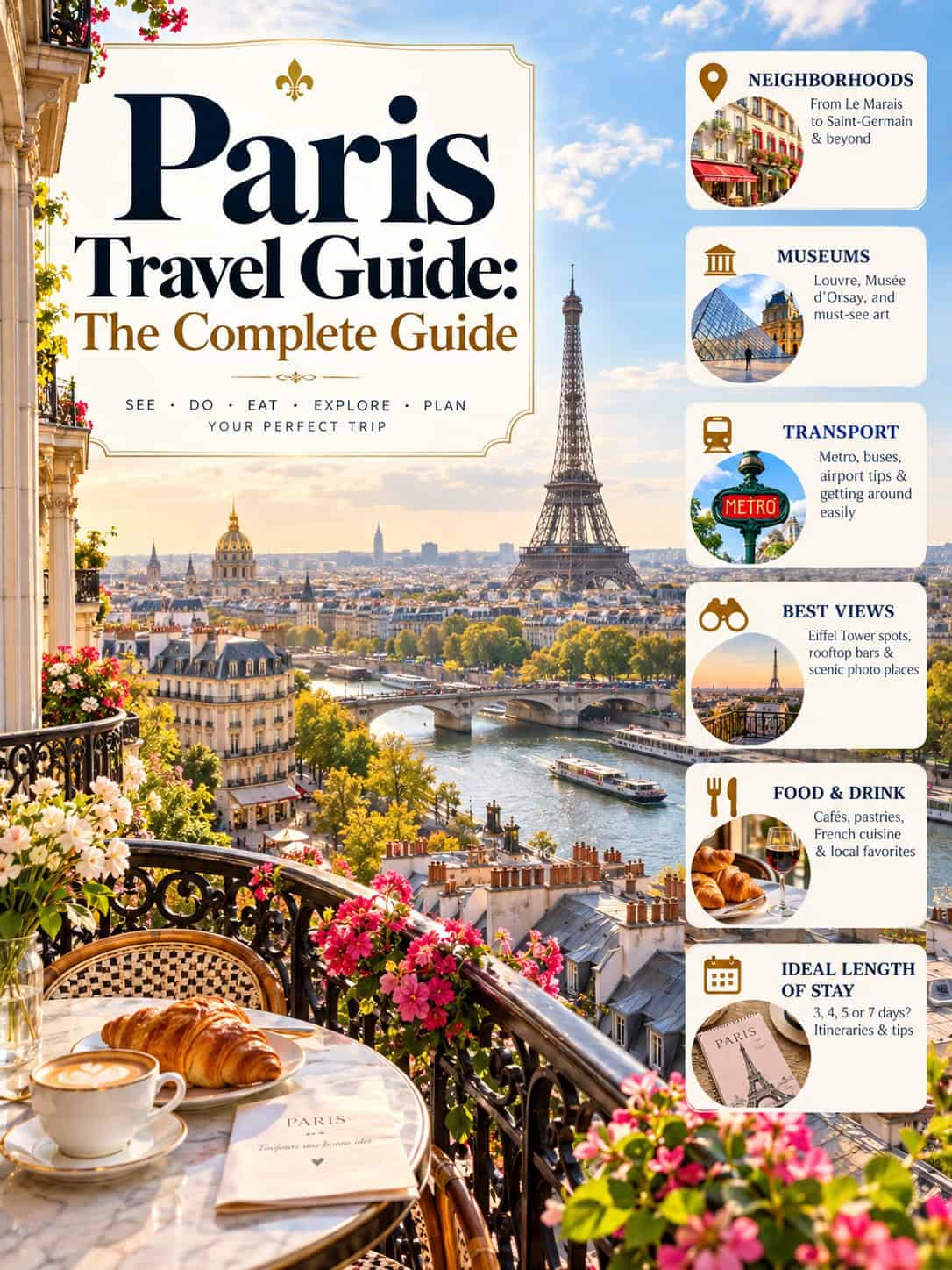
This Paris travel guide is built for people visiting Paris for the first time and for returning visitors who want a plan, not a list of 50 monuments. Paris is compact, walkable and layered, but it punishes improvisation in a few ways: timed tickets, closed days, airport transfers that need the right fare, and neighborhoods that feel nothing alike. Below you will find how many days to plan, how the city is organized, the best things to do in Paris with booking notes, how to move around, where to stay and how to fit day trips around the center. Confirm prices and hours on official sites before you pay, because they change.
Also available in: 中文 · 한국어 · 日本語
Paris Travel Guide: How Many Days in Paris? 3, 5 or 7 Days at a Glance
| Trip length | What to cover | Time per day | Book ahead |
|---|---|---|---|
| 3 days | Île de la Cité, the Louvre, the Orsay, the Eiffel Tower, Montmartre and the Marais | Full days, plus an evening Seine stroll | Louvre, Eiffel Tower, Sainte-Chapelle |
| 5 days | The three days above, plus a Versailles day and a loose day for the canal area and a market | Full days, with one slower day | Versailles palace, Orsay, Eiffel Tower slot |
| 7 days | The five days above, plus Giverny (spring to early autumn) or Disneyland, Père Lachaise and the Left Bank at a walking pace | Two day trips, the rest relaxed | Day-trip tickets, Orangerie, Arc de Triomphe rooftop |
Three full days cover the main sights at a steady pace. Five days let you add Versailles and leave space for neighborhoods. A week lets you add a second day trip without rushing. Fewer than three days means choosing between museums and exploring on foot.
How Paris Is Laid Out
In any Paris travel guide, the first thing to learn is the map. Paris is divided into 20 arrondissements that spiral clockwise from the 1st, at the center beside the Louvre, out to the 20th in the east. The last two digits of a Paris postcode (75001 to 75020) tell you the arrondissement, so a lower number usually means closer to the middle. The Seine splits the city into the Right Bank to the north and the Left Bank to the south.
Neighborhood names do not follow the official numbers. Montmartre, the Marais and Saint-Germain-des-Prés are historic quarters that existed long before the arrondissement system. Learn a handful of these names and you can read most maps.
- Louvre and Tuileries (1st): the grand axis, museums, gardens, and the most polished part of the center.
- The Marais (3rd and 4th): medieval streets, galleries, Place des Vosges and busy weekend crowds.
- Latin Quarter and Saint-Germain (5th, 6th): university streets, bookshops, cafes and the Luxembourg Gardens.
- Eiffel Tower and Invalides (7th): embassies, quiet residential blocks and the tower itself.
- Montmartre (18th): a hill village with steep stairs, Sacré-Cœur and the heaviest tourist pressure in the north.
- Canal Saint-Martin and Belleville (10th, 11th, 19th, 20th): younger and more local, better for cafes and evenings than for monuments.
Things to Do in Paris: 12 Big Sights and How to Book Them
The most useful rule is that the headline attractions run on reserved time slots. Walk-up visits are the exception, so decide your must-sees early and book them before you fix the rest of the schedule. This table lists the best things to do in Paris with a realistic visit time, whether to book and what is free.
| Sight | Plan on | Booking | Free or paid |
|---|---|---|---|
| The Louvre | About 3 hours | Reservation required; closed Tuesday | Paid |
| Eiffel Tower | About 2 hours | Book ahead; sunset slots go first | Paid (grounds are free) |
| Notre-Dame | About 45 minutes | Free reservation avoids the longest queue | Free |
| Sainte-Chapelle | About 45 minutes | Timed ticket advised; airport-style security | Paid |
| Musée d’Orsay | 2 to 3 hours | Book online; closed Monday | Paid |
| Musée de l’Orangerie | About 1 hour | Book online | Paid |
| Sacré-Cœur and Montmartre | About 2 hours | No booking; the dome costs extra | Basilica is free |
| Arc de Triomphe | About 1 hour | Book online for the rooftop | Paid |
| Luxembourg Gardens | 1 to 2 hours | None | Free |
| Seine cruise | About 1 hour | Optional | Paid |
| Place des Vosges and the Marais | About 2 hours | None | Free |
| Père Lachaise Cemetery | About 1.5 hours | None | Free |
The Louvre
The Louvre opens until 21:00 on Wednesday and Friday, is closed on Tuesday and requires a reservation on the official website. Visitors from outside the EU and EEA pay a higher ticket price than EU and EEA visitors. The late openings are the calmest slots. Plan on three hours for a focused visit, because trying to see everything is how people end up exhausted by noon.
The Eiffel Tower
Tickets for the lift and the stairs are released weeks ahead, and the good sunset slots vanish first. The view from the tower does not include the tower, so many travelers photograph it from across the river and keep the tower itself for the experience. If you are choosing where to sleep with the tower in mind, see our pick of hotels near the Eiffel Tower.
Notre-Dame, Sainte-Chapelle and the Île de la Cité
Notre-Dame has reopened to visitors after the fire. Entry to the cathedral is free, and a free reservation on the cathedral website lets you avoid the longest line. The Sainte-Chapelle sits inside the Palais de Justice, so everyone goes through airport-style security. The security queue, not the ticket queue, is the usual bottleneck, so a timed booking helps.
Musée d’Orsay and smaller museums
The Musée d’Orsay is closed on Mondays and open late on Thursdays. Its reception areas are under renovation while the galleries stay open, so book online and read the museum’s current entry instructions before you go. If your list is the Orsay, the Orangerie and a couple of smaller museums, the Impressionist rooms are a better use of an afternoon than a second hour in the Louvre.
Sacré-Cœur and Montmartre
The basilica is free to enter. Climbing the dome costs a small extra fee and means several hundred narrow steps with no lift, so check the basilica’s own site for current hours. This is also where the string-bracelet and petition tricks are most often reported. If someone grabs your wrist or thrusts a clipboard at you, keep walking.
Is the Paris Museum Pass worth it?
The pass covers more than 50 sites, including the Louvre, the Orsay and Versailles, and the clock starts at your first entry. Each site is a single entry, and many still require a free timed reservation. It pays off only if you will visit roughly four or more paid sites in a short window. For a trip built around one museum and a lot of walking, individual tickets are cheaper, so do the arithmetic with your own list.
Paris Travel Guide: Getting Around the City
You will spend most of your time on foot and on the Metro. A single ticket for the Metro, train and RER is called a t+ ticket, and the reusable Navigo Easy card holds single tickets or day passes. Paper tickets are being phased out, so load tickets onto a Navigo Easy card or the transit app. Our explainer on the Metro, RER and tickets covers zones, passes and the weekly Navigo option.
Three habits save the most time. Check the line direction by the terminus name on the platform sign, not by a cardinal direction. Allow extra minutes at big interchanges such as Châtelet-Les Halles, where changing lines can mean a long walk. Keep your phone and wallet in front pockets or zipped bags on crowded Metro cars and RER trains.
Arriving: Paris Airports
From Charles de Gaulle, the RER B takes roughly 35 to 50 minutes to Châtelet-Les Halles and runs every 10 to 20 minutes through the day. It uses a special airport ticket, which you load onto a Navigo Easy card or the transit app, and you cannot replace it with a normal t+ ticket. Orly is linked by Metro line 14, which takes 25 to 30 minutes from Châtelet and uses the same airport ticket. Fares, night alternatives and taxi basics are in our airport transfers for CDG and Orly.
Paris Travel Guide: Where to Stay
Choose the neighborhood before the hotel. For a first visit, the Marais, Saint-Germain and the streets around the Louvre put the most sights within a 20-minute walk and are well served by Metro lines. The Eiffel Tower area is quiet at night and short on late restaurants. Montmartre is atmospheric but hilly, and the stairs are real when you are carrying a suitcase. The Canal Saint-Martin area gives better value and a more local evening scene, at the cost of a longer trip to the main museums.
To compare the banks, see our picks of the best stays across the Right Bank, Left Bank and Marais. Paris adds a per-adult, per-night tourist tax that rises with the hotel star rating, so check the total at checkout. Children under 18 are exempt. Rooms in older buildings are often small and air conditioning is not universal, which matters in a July heat wave.
When to Go
Timing matters in any Paris travel guide: August has a reputation for emptiness, and it is partly deserved: some neighborhood bistros and shops post “fermé en août” signs until September, yet central Paris stays open for tourists. From early July to early September the Seine banks and canals host the Paris Plages urban beaches, and Bastille Day on 14 July brings a military parade on the Champs-Élysées and fireworks at the Eiffel Tower. Spring and early autumn usually balance mild weather with shorter queues. For a broader comparison, see our season-by-season timing across France.
Eating Well Without a Tourist Trap
Avoid restaurants with photo menus facing a major monument, walk two or three streets away from the sight, and eat your main meal at lunch, when many bistros offer a set menu. Buy a baguette or pastry at a boulangerie, a cheese from a fromagerie and fruit from a street market for a picnic by the Seine. Specific dishes, bakeries and market days are in our bistros, markets and pastries walkthrough.
Paris Travel Guide: Day Trips From the City
Three excursions dominate, and each needs its own day. Versailles is the easiest: the palace is closed on Mondays and the RER C reaches the town from central Paris. See our notes on the palace, gardens and Trianon estate and on reaching the palace by train, and check the official site for fountain-show days.
Monet’s house and gardens at Giverny are open seasonally, from spring to early November, so you cannot do it in winter. Train and bus details are in our Monet’s garden day trip. Disneyland sits at the end of the RER A at Marne-la-Vallée-Chessy, and park tickets and planning are covered separately. Do not combine Versailles and Disneyland in one day.
Paris or Somewhere Else?
Paris is a strong first stop but a poor fit for a plan built around beaches. If you are weighing it against the Riviera, our comparison of the capital and Nice sets out the differences in cost, climate and pace. A common pattern is three to five days in the capital, then a train south or west for contrast, and a two-week loop through the country shows one way to build it.
Paris Travel Itinerary: Sample Plans for a First Visit
Three days
- Day 1: Île de la Cité (Notre-Dame, Sainte-Chapelle), the Latin Quarter, the Luxembourg Gardens and an evening Seine stroll.
- Day 2: the Louvre in the morning, the Tuileries and the Orsay in the afternoon, the Eiffel Tower at a booked sunset slot.
- Day 3: Montmartre early, before the crowds, then the Marais and Place des Vosges.
Five days, with a day trip
Keep the three days above, add a full day at Versailles on any day except Monday, and keep a loose day for the canal area, a market and anything that drew you in. Spread booked sights across different days so one missed slot does not break the schedule.
Seven days
Keep the five days, then add Giverny in season or Disneyland, a morning at Père Lachaise and an afternoon on the Left Bank at a walking pace. Leave one afternoon with nothing booked.
Paris Travel Tips: Safety, Etiquette and Practical Points
Paris is generally fine for visitors, with petty theft the main problem. Pickpocketing concentrates at the Eiffel Tower, Notre-Dame, Sacré-Cœur, the Champs-Élysées and on Metro and airport trains. Greet shopkeepers with “bonjour” before asking anything, because it changes the tone of every transaction. Carry a second payment method and keep a small amount of cash for markets and bakeries. Sundays are quieter: many small shops close, though museums and tourist areas stay open. For more, see our practical notes on staying safe in France and on tipping and etiquette.
Frequently Asked Questions
How many days do you need in Paris?
Three full days cover the main sights. Five days let you add Versailles or Giverny and leave space for neighborhoods. Seven days let you add a second day trip.
What are the best things to do in Paris on a first visit?
The Louvre, the Eiffel Tower, Notre-Dame and the Sainte-Chapelle, the Orsay, Montmartre, a Seine cruise and a walk through the Marais. The table above shows how long each takes and whether to book.
Do I need to book Paris attractions in advance?
For the Louvre, the Eiffel Tower and the Orsay, yes. The Louvre requires a reservation, and the Eiffel Tower releases tickets weeks ahead. Notre-Dame is free, but a free reservation avoids the queue.
Is the Paris Museum Pass worth it?
Only if you will use it intensively, because many sites still need a free time slot. Add up individual ticket prices first.
What is the best way to get from the airport to central Paris?
From Charles de Gaulle most visitors take the RER B with the airport ticket. Orly is served by Metro line 14. Taxis and rideshares are an alternative with luggage.
Is Paris safe for tourists?
Yes for most visitors, but pickpocketing and street scams are common around major sights and on transit. Keep valuables in front, ignore clipboard petitions and string bracelets, and stay aware in crowds.
Bottom Line
Book the Louvre, the Eiffel Tower and any museum slots first, base yourself in a walkable central neighborhood, use a Navigo Easy card on the Metro and leave one unplanned afternoon. Everything else in this Paris travel guide is detail around that skeleton, and the details are worth confirming on official sites because prices and rules change.
Pingback: Best Hotels in Paris: Right Bank vs Left Bank vs Marais.
Pingback: 파리 최고의 호텔: 센강 우안 vs 센강 좌안 vs 마레 지구.
Pingback: パリのおすすめホテル:セーヌ右岸・左岸・マレ地区を比較.
Pingback: Paris to Versailles: Train, RER C, Bus and Tickets.
Pingback: Paris Protests Shut 25 Metro Stations: What to Know
Pingback: France Events October 2026: Festivals and Travel Tips.
Pingback: Giverny Day Trip Guide: Monet's Garden from Paris
Pingback: エッフェル塔周辺のおすすめホテル:パリのおすすめの宿泊エリア.
Pingback: Loire Valley Chateaux Guide: Where to Go & How to Plan
Pingback: Best Hotels Near Eiffel Tower: 8 Top Stays by Area
Pingback: French Food Guide: 15 Traditional Dishes by Region
Pingback: Versailles Visitor Guide: Tickets, Gardens and Trianon
Pingback: Paris Food Guide: What to Eat, Bistros and Markets
Pingback: Things to Do in Lyon: Top 10, Traboules and Bouchons
Pingback: Disneyland Paris Guide: Parks, Tickets and Planning
Pingback: France vs Italy: Best Places, Food, Costs and Travel Tips
Pingback: Paris Metro Tickets: Fares, Passes and Easy Travel