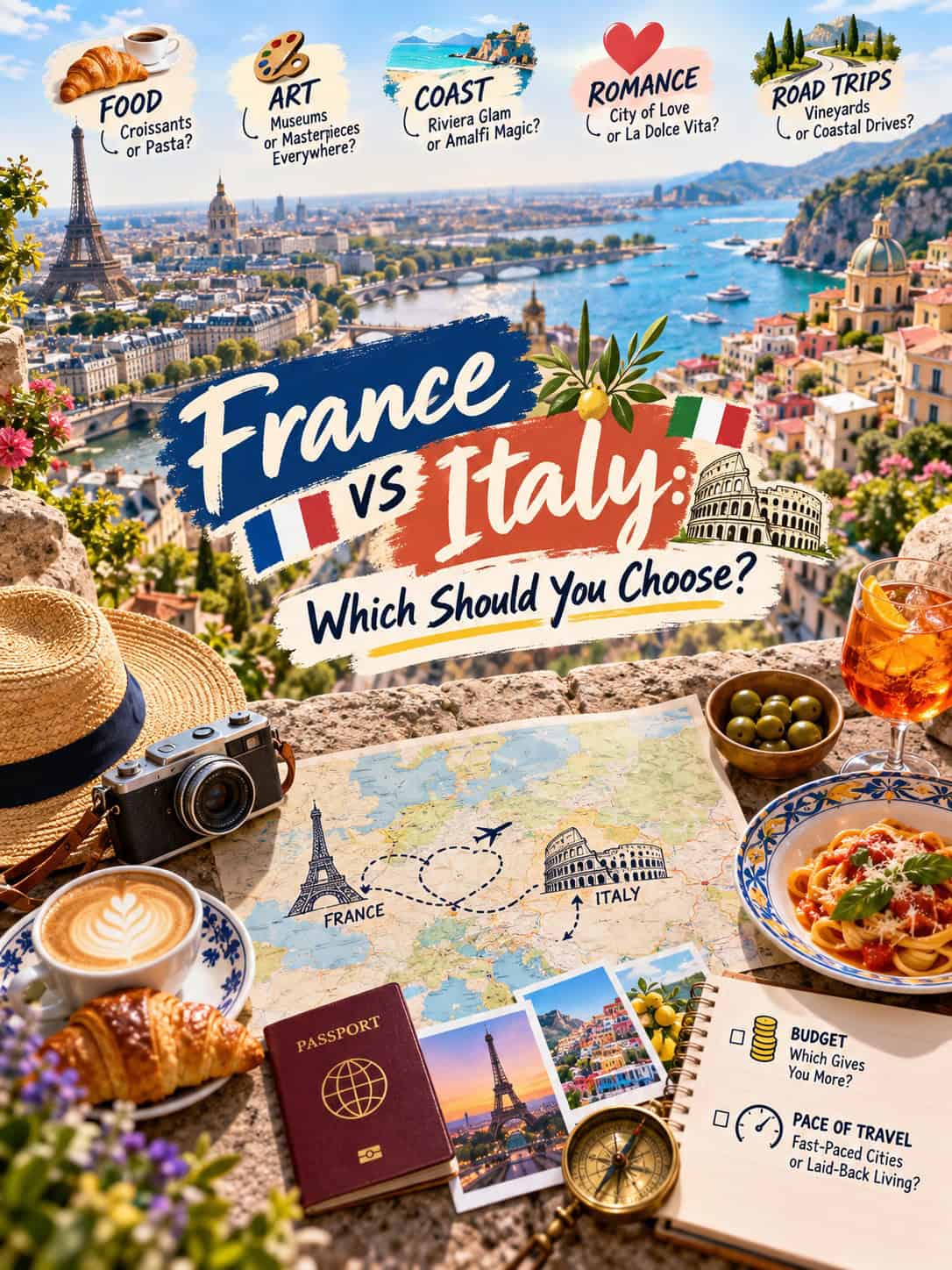
France vs Italy is a choice between two rewarding but different travel styles: France excels at varied regions and museums, while Italy offers compact city itineraries and ancient sites. France is bigger, more varied in landscape, and easier to cover by fast train; Italy is more compact, more food-and-ruins intense, and rewards slowing down in one region. This guide compares the two on the things that actually decide a trip: first-trip suitability, food and wine, art and history, landscapes, beaches, transport, crowds, the best season and the practical admin. It ends with a quick decision guide so you can choose in a few minutes.
France vs Italy: The Quick Decision Guide
- Choose France if you want varied landscapes (Alps, Atlantic coast, vineyards, castles, Mediterranean), city breaks built around museums and cafe culture, wine regions with a serious touring infrastructure, or a long road or rail trip with distinct regions.
- Choose Italy if ancient Rome, Renaissance Florence, Venice and a cuisine that changes every hundred kilometers are your priorities, or if you want a trip based on a handful of famous cities plus a lake, coast or hill-town extension.
- Choose France if you are traveling with kids who like castles, beaches and theme parks, or if you want skiing alongside summer options in the same country.
- Choose Italy if you are a first-time European traveler who wants the greatest density of famous sights per day of travel.
France vs Italy Travel: Landscapes and Trip Style
France is the larger country by a clear margin (roughly 544,000 km² against about 301,000 km² for Italy, so around 1.8 times larger by land area) and its geography is unusually varied: the Alps and Pyrenees, the Atlantic and Channel coasts, the Mediterranean, big river valleys, volcanic uplands in the Massif Central, and vast agricultural plains. Italy is long and narrow, running from the Alps down to Sicily, and its character changes more by north-south latitude and by city than by landscape type.
That difference shapes itineraries. A France trip often links a few regions (Paris, a river valley, the south), while an Italy trip tends to link a few cities (Rome, Florence, Venice) with side trips. If you like the first model, our France 10-Day Itinerary: Paris, Loire Valley and Provence shows how a three-region trip works in practice.
France vs Italy Food and Wine
A France vs Italy food comparison starts with two distinct culinary traditions, both strongly regional. Italian cooking is fiercely regional and ingredient-led: pasta shapes, cheeses, cured meats and even bread change from one region to the next, and a simple dish done well is the point. French cuisine has a stronger tradition of technique, sauces, pastry and bakery culture, along with famously regional cooking in places like Lyon, Alsace, Brittany and the Southwest.
For a France vs Italy wine comparison, France offers Bordeaux, Burgundy, Champagne, the Loire and the Rhône, while both countries have extensive wine regions and tasting opportunities. Italy counts Tuscany, Piedmont and the Veneto among its best-known wine regions, and its wine is generally easy to enjoy with meals at casual restaurants. Neither is a wrong choice; the practical difference is that French wine tourism often needs more advance booking at the famous estates, while Italian agriturismo-style stays make wine and food feel more casual.
| Food question | France | Italy |
|---|---|---|
| Signature strength | Technique, bakeries, cheese, regional cooking | Regional pasta, pizza, gelato, fresh produce |
| Eating style | Set lunch menus are common; dinner service typically runs from about 7:30 pm | Long, relaxed meals; many restaurants do not take dinner bookings before 8 pm |
| Casual options | Bakery sandwiches, cafe lunches, markets | Bars with pastries and coffee, pizza by the slice, market stalls |
| Vegetarian travelers | Often more limited in traditional restaurants; check menus ahead | Often easier thanks to vegetable-forward dishes, though this varies by restaurant |
France vs Italy: Art, History and Famous Sights
Italy is the heavyweight for ancient and Renaissance history: the Roman Forum and Colosseum, the Vatican, the Uffizi in Florence, Venice’s canals and Pompeii are all world-class on their own. France counterbalances with the Louvre and the Musee d’Orsay, Versailles, medieval cathedrals and abbeys, the D-Day sites, Roman remains in Provence (such as the Pont du Gard and Arles), and a long list of Loire castles.
If one city decides your trip, compare Rome with Paris directly. Paris is a city of neighborhoods, museums, gardens and cafe terraces; Rome layers ancient ruins and baroque piazzas over a lively, noisy street life. Our Paris Travel Guide: The Complete Guide gives the French side of that comparison in detail.
Landscapes, Beaches and Outdoors
For beaches, both countries have excellent options but of different types. France’s Mediterranean coast around the Riviera combines pebble and sand beaches with glamorous towns, while Brittany and Normandy offer dramatic tidal Atlantic and Channel coastlines that are about walking, seafood and big skies rather than hot-weather swimming. Italy’s coast ranges from Liguria and the Amalfi coast to sandy Adriatic beaches and Sardinia and Sicily. If the French Riviera appeals, see the Nice and the French Riviera Travel Guide: The Complete Guide.
For mountains, both share the Alps. France has Mont Blanc and a huge ski industry; Italy has the Dolomites and Lake Como’s mountain backdrop. For lakes and hill towns, Italy has a slight edge in postcard density (Lake Como, Lake Garda, Tuscan hill towns), while France has quieter, less-visited rural areas such as the Dordogne, the Auvergne and Burgundy where you can travel for days without a major crowd.
France vs Italy: Getting Around by Train and Car
Both countries have strong high-speed rail networks that link the main cities, and in both it is generally easier and less stressful to travel city to city by train than to drive. France’s high-speed network is a hub-and-spoke system centered on Paris, with main lines running north toward Lille, southwest toward Nantes and Bordeaux, and southeast toward Lyon and Marseille, so many cross-country journeys route through the capital, although direct regional links exist. Italy’s main high-speed axis runs from Turin and Milan through Bologna, Florence and Rome to Naples and Salerno, served by both state-run Trenitalia (Frecciarossa) and the private operator Italo, which suits a classic city-hopping route very well. The booking platform in France is SNCF Connect; for Italy, check Trenitalia and Italo directly for current timetables (Milan to Rome takes under three hours on the fastest services, according to rail-travel guides).
Driving is where the countries differ. Rural France is excellent for road trips, with well-maintained roads and plenty of parking in small towns. In Italy, many historic centers restrict traffic to residents through limited traffic zones (known as ZTL), and tourists who drive into one by mistake can receive a fine by mail weeks or months later, via the rental company, which typically adds an administrative fee. Driving into an unauthorized ZTL can result in a fine, and repeated entries can lead to separate penalties. Check access signs and local restrictions before entering a historic center. If you rent a car in Italy, plan to park outside the old town and walk in. Always check the current rules for each city before you go.
France vs Italy: Crowds and Quieter Alternatives
France welcomed approximately 102 million international tourists in 2024, compared with around 57.7 million for Italy. In both countries, crowds concentrate around major landmarks and peak holiday periods. Italy’s crowds are even more concentrated in its short list of icons: Rome, Florence, Venice, the Amalfi coast and the Cinque Terre. A day in any of these can feel congested at peak times.
The practical tip for both is to book timed tickets for major attractions, start early, and pair every famous stop with a lesser-known one. France’s depth of quiet regions gives you more room to escape; Italy’s smaller towns do too, but you have to plan deliberately to find them.
France vs Italy: Choosing the Right Season
The shoulder months of spring and early autumn are the best time to visit either country: comfortable temperatures, reasonable crowds and most attractions open. Summer is hot in both, particularly in southern France and in Italian cities like Rome, Florence and the south, and August brings an extra layer of holiday closures: in Italy small family-run restaurants and shops often close for two to three weeks around Ferragosto (15 August), and in France many restaurants and small businesses post a fermeture annuelle, often in a window around early to late August, though tourist-oriented businesses stay open. Winter suits city museum trips and skiing, but coastal and rural areas can be quiet, with some seasonal places closed. Our Best Time to Visit France: A Season-by-Season, Region-by-Region Guide covers the French calendar in detail; for Italy, look up the same factors for each city you plan to visit.
| Season | France | Italy |
|---|---|---|
| Spring | Pleasant, gardens in bloom, good for Paris and the Loire | Good for Rome, Florence and the south before the heat |
| Summer | Beaches, lavender, festivals; heat and crowds in the south | Beaches and lakes; Rome and Florence can be very hot |
| Autumn | Wine harvest, comfortable temperatures | Harvest season, truffles and mushroom dishes in some regions |
| Winter | Christmas markets, museums, skiing | Fewer crowds in cities, skiing in the Alps and Dolomites |
Practical Matters: Visas, Money and Language
France and Italy are both in the Schengen Area and use the euro. If you need a short-stay Schengen visa to visit both, apply through the country that is your main destination; if no main destination can be determined, apply through the country you will enter first. Entry requirements depend on your nationality. Our France Visa Guide (Schengen): Who Needs One and How to Apply covers the process from the French side.
For budgeting, both countries range from affordable to very expensive depending on city, season and style. Compare actual costs for your dates rather than relying on reputation; our Money in France: Currency, ATMs and Daily Costs explains how payments, cash and everyday spending work in France, and similar principles apply in Italy. Cards are widely accepted in both, but carrying a small amount of cash is useful for small cafes, bakeries and markets.
On language, English is usually workable in the main tourist areas of both countries, but a few words of the local language are appreciated and make a real difference. French politeness conventions, such as greeting shopkeepers with a quick bonjour, matter. In Italy, greeting staff and learning a few basic phrases is likewise good manners.
Which Is Better For Your Traveler Type?
| Traveler | Better fit | Why |
|---|---|---|
| First trip to Europe, 7-10 days | Italy or France | Italy’s Rome-Florence-Venice circuit is compact; France’s Paris plus one region is easier on the schedule |
| History and archaeology fans | Italy | Ancient Rome, Pompeii and Renaissance cities |
| Wine and countryside | France | Greater variety of wine regions and rural touring |
| Family with children | France | Castles, beaches, parks and varied activities |
| Road trippers | France | Easier driving and parking in rural areas |
| Food-focused short break | Either | Pick one city and eat well |
| Skiing plus a summer option | Either | Both have major Alpine skiing |
Can You Combine Both?
Yes, and many travelers do. The simplest combination links the French Riviera with Liguria and then Tuscany, or links Paris with a train or flight into northern Italy. The common mistake is trying to see too much; a trip of less than two weeks is usually happier if you choose one country and add a short extension rather than splitting time evenly. Check the current train and flight options and book early where timed entry applies. If you are choosing France or Italy for vacation, start with the experience you value most: museums and varied regions in France, or ancient sites and closely linked historic cities in Italy. A France vs Italy travel itinerary works best when it limits long transfers and leaves enough time for each destination.
Bottom Line
Pick Italy if you want the densest concentration of ancient and Renaissance icons and a trip built around cities and regional food; pick France if you want variety, rural touring, wine regions and the freedom to mix a great capital with coast, mountains or castles. If you are still undecided, choose by season: what is at its best when you are free to travel will usually make the decision for you.
Frequently Asked Questions
Is France or Italy better for a first trip to Europe?
Both work well. Italy suits travelers who want an iconic city circuit packed with historic sights, while France suits those who want one great city plus a distinct region such as the Loire or Provence. Choose based on whether you prefer art and ruins or varied scenery.
Is France or Italy Cheaper to Visit?
If you are asking whether France or Italy is cheaper to visit, the answer depends on the cities, dates and travel style rather than the country alone. Compare the actual cost of accommodation and transport for your dates, and consider traveling in shoulder season in either country.
Do I need separate visas for France and Italy?
Both are in the Schengen Area, so one Schengen visa generally covers both if you need a visa at all. Check the official requirements for your nationality before applying.
Which has better food, France or Italy?
They are both outstanding and it comes down to taste. Italy is stronger on regional pasta, pizza and gelato; France is stronger on bakeries, pastry, cheese and classic technique.
Which is easier to travel without a car?
Both have good train networks. France’s network radiates from Paris, while Italy’s main line connects its big cities in a north-south chain, which suits city-hopping.
Pingback: Best Time to Visit France: Season & Region Guide.