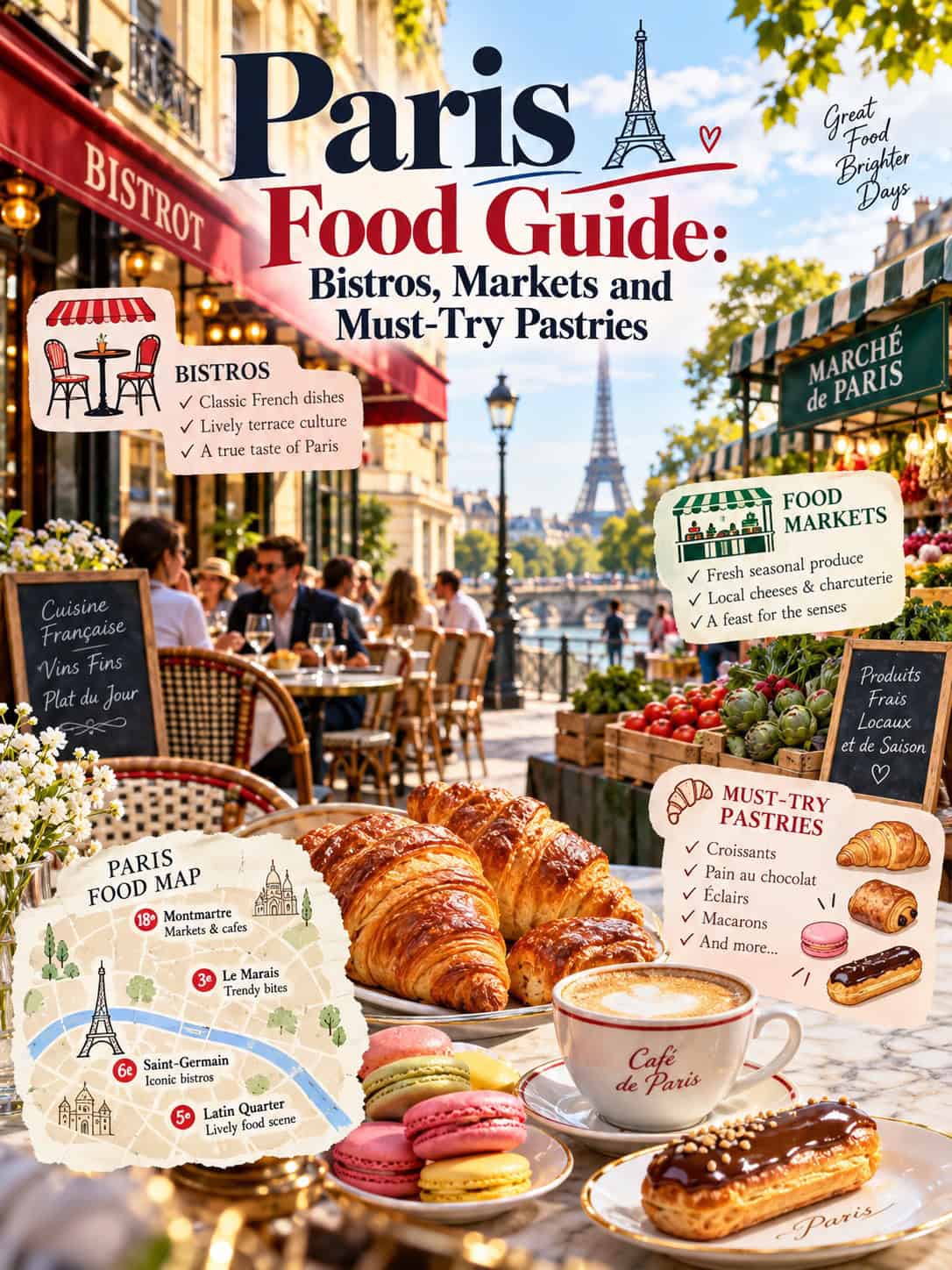
This Paris food guide is built for visitors who want to eat well without spending every meal in a queue or a tourist trap. Paris rewards a little planning: the city runs on rhythms (a set lunch at midday, a bakery run in the morning, an apéritif before dinner) and once you fit into them, eating gets easier, better and usually cheaper. For the wider picture of the city, see our Paris travel guide; for dishes you will meet beyond the capital, our French food guide to regional dishes goes region by region.
What to Eat in Paris: 10 Classics at a Glance
| What to eat | Where to find it | Budget |
|---|---|---|
| Croissant and pain au chocolat | Neighborhood boulangerie | € |
| Jambon-beurre (ham and butter baguette) | Boulangerie or café | € |
| Croque-monsieur | Café | €-€€ |
| Crêpes, sweet or savory | Crêperie | €-€€ |
| Soupe à l’oignon (onion soup) | Bistro or brasserie | €€ |
| Steak frites | Brasserie or bistro | €€ |
| Escargots | Bistro | €€ |
| Cheese, from a shop or as a course | Fromagerie, or bistro before dessert | €-€€ |
| Éclair, mille-feuille and other pâtisserie | Pâtisserie | € |
| Tarte Tatin or tarte au citron | Bistro dessert or pâtisserie | €-€€ |
The symbols are relative: € is a snack or bakery item, €€ is a sit-down bistro or brasserie dish. For a quick feel for the day, here is where to go at each time:
| Meal | Where to go | What to order |
|---|---|---|
| Breakfast | Boulangerie or café | A croissant and a café, or a tartine with butter and jam |
| Lunch | Bistro (look for a formule) or a market picnic | A starter and main or main and dessert; bread, cheese and fruit from a market |
| Snack | Boulangerie or pâtisserie | A jambon-beurre, a pastry or crêpes |
| Dinner | A booked bistro or a brasserie | Steak frites, a plat du jour or a seasonal chalkboard dish |
How Eating Works in Paris: A Paris Food Guide to the Rhythm of the Day
Meals in Paris follow a schedule more rigidly than visitors expect. Lunch is usually served from around noon to about 2:30 pm, dinner from around 7 pm to 10:30 pm, and many traditional restaurants stop taking orders in the mid-afternoon and reopen for dinner in the evening. Dinner tends to start later than in much of the English-speaking world. Arrive at a classic bistro at an off-hour and you may find the kitchen closed; look for signs saying service continu, or head to a brasserie, which usually keeps its kitchen running through the afternoon.
Three habits make a difference. First, lunch is where the value lives: many bistros offer a fixed-price formule at midday (a starter plus main, or main plus dessert) that costs noticeably less than ordering the same dishes in the evening. Second, a short menu written on a slate usually signals a kitchen cooking what the market offered that morning. Third, reservations matter more than people think. Popular small bistros have few tables, so book ahead for dinner, and for any place you have set your heart on. Check each restaurant’s own booking method, as they vary.
Paris Food Places: The Types of Places You Will Eat
| Type | What it is | Best for |
|---|---|---|
| Bistro | Small, informal, short menu of traditional home-style dishes | A classic Parisian dinner or a lunch formule |
| Brasserie | Larger, often with long hours, serving oysters, seafood platters and standards such as steak frites | Eating outside standard meal times, groups |
| Café | Coffee, drinks, simple dishes such as a croque-monsieur or an omelette | Breakfast, a light lunch, people-watching |
| Boulangerie | Bakery for bread, viennoiseries and often sandwiches | Breakfast, picnic lunches, a cheap quick bite |
| Pâtisserie | Pastry shop for cakes, tarts and éclairs | Dessert, gifts, an afternoon treat |
| Fromagerie / charcuterie | Cheese and cured-meat specialists | Picnic provisions |
| Marché (market) | Open-air or covered market with produce, cheese, bread and prepared food | Atmosphere and picnic shopping |
A bistro and a brasserie are easy to confuse. The practical difference for a traveler is that a brasserie is generally bigger and more likely to keep a kitchen running through the day, while a bistro is smaller and more tied to set lunch and dinner services. Neither word guarantees quality, so judge the place by the menu rather than the sign.
Classic Paris Food: Bistro Dishes to Order
The traditional Parisian repertoire is hearty, built on butter, wine and slow cooking. These are the dishes worth recognizing on a chalkboard menu.
- Soupe à l’oignon: onion soup topped with bread and melted cheese, a cold-weather staple. The cheese-topped version is tied to the old Les Halles market, where it fed market workers and late-night revelers.
- Steak frites: steak with fries, the benchmark order in a brasserie. Cooking terms differ from English: bleu is barely seared, saignant roughly medium-rare, à point closer to medium, and bien cuit well done. The French scale runs a notch rarer than the American one, so many visitors find that à point arrives pinker than expected; adjust your order accordingly.
- Steak tartare: raw minced beef seasoned with capers, shallot and condiments. It is usually served raw by design, so order it only if that is what you want.
- Boeuf bourguignon and coq au vin: beef and chicken braised in red wine. Both are associated with Burgundy but appear on Parisian bistro menus.
- Confit de canard: duck leg slow-cooked in its own fat, usually with crisp potatoes. The dish comes from the southwest but is a fixture in the city.
- Poireaux vinaigrette and œuf mayonnaise: simple cold starters (leeks in vinaigrette, boiled egg with mayonnaise) that tell you a bistro takes tradition seriously.
- Escargots: snails baked in garlic and parsley butter. Order them once; whether you love them is a matter of taste.
- Croque-monsieur: a toasted ham-and-cheese sandwich, with the croque-madame adding a fried egg. Widely served in cafés.
- Cheese course: in a traditional meal, cheese arrives before dessert, not as a starter.
Reading a French menu
A carte is the full à la carte menu; a menu in France is a fixed-price set meal, not the list of dishes, which is a classic source of confusion. Entrée means starter, plat is the main course, and dessert is what it looks like. Plat du jour is the dish of the day. A carafe d’eau is free tap water, and asking for it is normal and polite (and a legal entitlement in restaurants); for how much to leave at the end of the meal, see our guide to tipping and etiquette in France.
Best Pastries in Paris: Must-Try Viennoiseries and Pâtisserie
Pastry is where Paris food is hardest to beat. You do not need an expensive address: a good neighborhood boulangerie can match a famous shop on the basics. Here is what to look for.
Morning viennoiseries
- Croissant: the test of any bakery. A good one is flaky and layered with a honeycomb interior, and smells of butter. Croissants labeled au beurre are made with butter; ordinary ones can use other fats. A straight-shaped croissant is traditionally the all-butter version and a curved one the version made with other fats, though this is an unwritten rule of thumb: the bakers’ federation says there is no official rule on croissant shape.
- Pain au chocolat: laminated dough around chocolate batons. In southwest France the same pastry is called a chocolatine, a point of regional pride, but in Paris say pain au chocolat.
- Pain aux raisins: a spiral with custard and raisins.
- Chausson aux pommes: an apple turnover.
Classic pâtisserie
- Éclair: choux pastry filled with cream (coffee and chocolate are the standards) and glazed on top.
- Mille-feuille: layers of puff pastry and crème pâtissière, notoriously awkward to eat politely.
- Paris-Brest: a ring of choux pastry with praline cream, created in 1910 by pâtissier Louis Durand to mark the Paris-Brest-Paris cycle race, its ring shape evoking a wheel.
- Religieuse: two stacked choux balls filled with cream, said to resemble a nun in habit.
- Tarte au citron and tarte Tatin: lemon tart and the upside-down caramelized apple tart.
- Macarons: almond meringue sandwiches. Not the same thing as a macaroon. They are a refined treat rather than a daily bakery item.
- Canelé: a small caramelized cake with a custardy center, from Bordeaux, where it is linked to convent kitchens and the wine trade, but easy to find in Paris.
- Financier and madeleine: small buttery cakes, good for a coffee break.
- Baba au rhum and fraisier: a rum-soaked cake and a strawberry-and-cream cake, respectively.
Bread deserves attention too. The baguette de tradition is governed by a 1993 decree: only wheat flour, water, salt and yeast or sourdough, with no frozen dough and no additives, which is why it usually tastes better than a plain baguette. The French term pain covers dozens of loaves, so point at what looks good. Bakeries commonly close one or two days a week and often take a summer break, so check before you plan a bakery-centered morning.
Paris Food Markets: Where to Shop and Eat Like a Local
Paris counts roughly 80 food markets, most of them open-air markets that run on set days of the week, plus a handful of covered markets that open on more days. Many food markets are closed on Mondays, and open-air markets typically run from morning to early afternoon. Opening days and hours differ by market, so check the market you plan to visit before you go. The Marché des Enfants Rouges at 39 rue de Bretagne in the Marais is the city’s oldest covered market and has food counters where you can sit and eat; the nearest Métro stop is Filles du Calvaire. Other markets worth knowing are the Marché d’Aligre in the 12th (Métro Ledru-Rollin), the open-air Marché Bastille near the Bastille Métro and the covered Marché Saint-Quentin in the 10th near Gare de l’Est. Their days and hours differ, so check them before you plan a visit. Some basics of how markets work:
- Go in the morning for the best choice; many stalls wind down around lunchtime.
- Cash is useful at small stalls, though many vendors now accept cards.
- Say bonjour before you ask for anything. It is the single most useful bit of etiquette.
- Do not handle produce unless invited; vendors often pick items for you. Say how ripe you want things, for example pour manger ce soir (to eat tonight).
- Buy cheese, bread, fruit, charcuterie and a bottle and picnic by the Seine, in a park or on the bank of the Canal Saint-Martin.
Markets also suit a budget: a picnic assembled from a fromagerie, a boulangerie and a produce stall is one of the more affordable ways to eat memorably in the city. Covered markets and market streets inside the city often have prepared food and counters where you can eat on the spot.
Where to Eat in Paris by Neighborhood
Where you sleep shapes where you eat. If you are still choosing your base, our guide to where to stay in Paris on the Right Bank, Left Bank and in the Marais pairs well with this section.
| Area | Food character | Watch out for |
|---|---|---|
| Le Marais | Old streets with falafel counters, bakeries, wine bars and the historic Jewish quarter around the rue des Rosiers | Crowds on weekends; some businesses close on Saturdays or keep different hours |
| Latin Quarter and Saint-Germain | Classic bistros, cafés with literary history, wine bars, crêperies | Streets nearest the major sights lean toward tourist menus |
| Montmartre | Hillside bistros and bakeries away from the main square | The streets around the busiest squares are the most touristy |
| Canal Saint-Martin and the 10th | Casual cafés, brunch spots, small modern restaurants | Popular places fill up in the evening |
| Bastille, Oberkampf and the 11th | Bars and neo-bistros, a younger crowd | Late nights and noise |
| Belleville and the 13th | Chinese, Vietnamese and other Asian cooking, including pho and dumplings | Some places are cash-only or have few English menus |
| Les Halles and the Opéra area | Large brasseries and department-store food halls | Heavy tourist traffic |
Paris is also a strong city for non-French food. Because of its history, you can find excellent North African, West African, Lebanese, Vietnamese, Japanese and Indian cooking, often at a lower price than a classic French dinner. A couscous or a bowl of ramen on a night when you are tired of cream sauces is a perfectly good Paris meal.
How to Avoid Tourist Traps
- Be wary of menus in many languages with photos. A very long menu suggests a kitchen working from the freezer.
- Walk two or three streets away from major sights. Restaurants beside a famous landmark rely on passing trade rather than repeat customers.
- Look for the chalkboard. A short, changing list is a sign of cooking to the season.
- Check who is eating. A lunchtime room full of office workers is usually a good sign.
- Be careful with touts standing outside inviting you in.
- Read the bill. Service is included in menu prices in France (the bill reads service compris), and any extra tip is optional, usually just rounding up.
Paris Food and Drink: Coffee, Wine and Water
Ordering a café gets you a small espresso. A café crème or noisette adds milk, and a café allongé is longer. Large milky coffees are traditionally a breakfast drink rather than an after-dinner choice. Prices in cafés are often higher when you sit at a table or on the terrace than when you stand at the bar, so a quick coffee at the counter is usually the cheaper way to do it. A café noisette is an espresso with a dash of milk foam.
Wine is part of the culture, and house wine by the glass or the pichet (small jug) is a safe, economical option in a bistro. If you want to dig deeper into French wine, read our guide to the best wine regions in France. A traditional apéritif might be a glass of wine, a kir (white wine with blackcurrant liqueur), or a pastis. Tap water is safe to drink in France. Under French law, restaurants must serve free tap water on request, so ask for une carafe d’eau (or un pichet d’eau); just saying eau can get you a bottle that is charged. Cafés and bars that do not serve food may charge for a glass of water if the price is displayed.
Dietary Needs in Paris
Traditional French cooking is meat-, dairy- and butter-heavy, so vegetarians and people with allergies should plan ahead. The situation has improved, and many restaurants now have vegetarian options, but do not assume a dish is meat-free: soups can be made with meat stock, and salads may arrive with bacon. Useful phrases are Je suis végétarien(ne) and Je suis allergique à…. Be specific, because “no meat” is not always understood to exclude fish, ham or lard. Vegan and gluten-free options are easier to find in newer, more international restaurants and in neighborhoods with younger crowds than in the old-school bistros. For severe allergies, confirm with the staff directly and consider carrying a written card in French.
A Budget Food Route Through the Marais and Bastille
- Breakfast: a croissant and a coffee at the counter of a Marais boulangerie.
- Lunch: a seat at the counters of the Marché des Enfants Rouges, or a formule at a nearby bistro.
- Afternoon: a stroll through the Marais, then on toward Bastille for a pastry stop.
- Picnic or dinner: if a market is open near Bastille or Aligre, assemble a picnic of bread, cheese and fruit; otherwise book a bistro table in the 11th.
The two districts neighbor each other, so you can walk or take a short Métro ride between them. Check which market days fit your dates.
A Sample Paris Food Day
- Morning: a croissant and a coffee from a neighborhood boulangerie, eaten on the way to your first sight.
- Late morning: a walk through a market street to put together a picnic.
- Lunch: a bistro formule, or the picnic by the river.
- Afternoon: a pastry stop. Choose one pastry and share it so you can try more than one shop.
- Evening: an apéritif at a café terrace, then dinner at a booked bistro.
To reach these neighborhoods easily, our explainer on getting around Paris by metro, RER and ticket type covers the basics. Many of the best food streets are walkable from one another, so plan by area rather than hopping across the city.
Frequently Asked Questions
Is it rude to ask for tap water in Paris?
No. Ask for une carafe d’eau. Restaurants in France are required by law to provide it free on request, and they must display a notice saying so. The wording matters: ask for une carafe d’eau, not just de l’eau.
Do I need reservations at Paris restaurants?
For dinner at small bistros and popular places, yes, it is wise to reserve. For brasseries, casual cafés and lunchtime meals you can often walk in, but busy times fill up.
When should I eat lunch and dinner?
Lunch is typically served around midday into the early afternoon, and dinner starts later in the evening. Many traditional restaurants close their kitchens between services; brasseries and cafés are the flexible option.
What is the cheapest way to eat well in Paris?
Order the lunchtime formule, buy a sandwich or quiche from a boulangerie, and assemble a picnic from a market. Standing at the counter for coffee is cheaper than sitting down.
What does ‘menu’ mean on a French restaurant board?
It is a fixed-price set meal with a set number of courses. The list of all the dishes is the carte.
Can vegetarians eat well in Paris?
Yes, with some care. Look for restaurants that mark vegetarian dishes, ask about stock and bacon, and use the neighborhoods with international cooking when traditional menus offer little.
Bottom Line
The best way to enjoy Paris food is to follow local rhythms: a bakery in the morning, a set lunch, a market picnic, and a booked bistro table in the evening. Skip anything with a view of a landmark and a menu in six languages, choose short menus, and spend your pastry budget on variety rather than famous names. Verify opening days, hours and booking details with each place before you go, since they change.
Pingback: Paris Travel Guide: Sights, Tickets and Planning Tips
Pingback: French Food Guide: 15 Traditional Dishes by Region