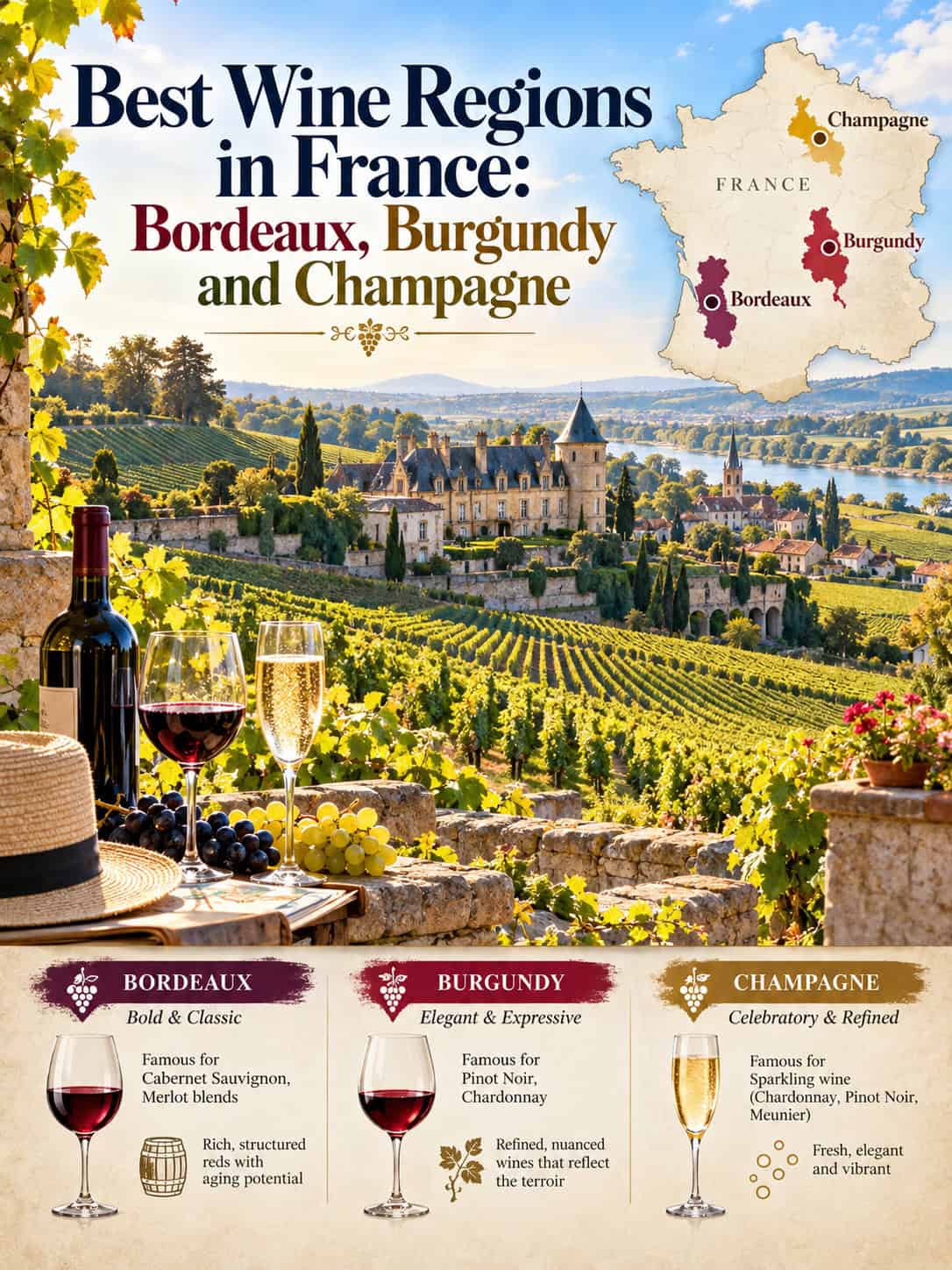
French wine regions are best chosen by travel style rather than ranking. Among French wine regions, the Bordeaux wine region, the Burgundy wine region and the Champagne wine region are the big three for visitors, and they could hardly be more different: Bordeaux is grand châteaux and blended reds, Burgundy is small family domaines and single-grape wines tied to named village plots, and Champagne is chalk cellars and sparkling wine made by a handful of famous houses and thousands of growers. This guide to French wine country explains what defines each region, how a visit actually works, how to get there without a car, when to go, and which of the best wine regions in France, from the Alsace wine route to the Loire, deserve a place on the shortlist, with a short guide to French wine appellations on the label.
French Wine Regions at a Glance
| Region | Main styles | Main grapes | Base for visitors | Best for |
|---|---|---|---|---|
| Bordeaux | Red blends, dry and sweet whites | Merlot, Cabernet Sauvignon, Cabernet Franc, Sémillon, Sauvignon Blanc | Bordeaux city, Saint-Émilion | Grand estates, architecture, a real city stay |
| Burgundy | Pinot Noir reds, Chardonnay whites | Pinot Noir, Chardonnay | Beaune, Dijon | Village wandering, cycling, food pairing |
| Champagne | Sparkling wine | Chardonnay, Pinot Noir, Meunier | Reims, Épernay | Cellar tours, a day trip from Paris |
| Loire Valley | Whites, rosés, light reds, sparkling | Sauvignon Blanc, Chenin Blanc, Cabernet Franc | Tours, Angers, Sancerre | Châteaux plus wine, relaxed pace |
| Rhône Valley | Syrah-led reds, Grenache blends, aromatic whites | Syrah, Grenache, Viognier | Lyon, Avignon | Bold reds, scenic hillside terraces |
| Alsace | Dry aromatic whites | Riesling, Gewürztraminer, Pinot Gris | Colmar, Strasbourg | Half-timbered villages, the wine route |
| Provence | Mostly rosé, plus reds and whites | Grenache, Cinsault, Syrah, Mourvèdre | Aix-en-Provence, Avignon, Marseille | Rosé, sunny countryside |
| Languedoc | Varied reds, whites and rosés, value-led | Grenache, Syrah, Carignan, Mourvèdre | Montpellier, Narbonne | Wide choice, lower prices |
| Beaujolais | Light, fruity reds | Gamay | Lyon | A relaxed alternative to neighboring Burgundy |
Treat the table as orientation, not a ruling. Each region has dozens of sub-areas with their own character, and the quality range within any of them is enormous.
France Wine Regions Map in Words: Where Each One Sits
Here is a text version of a French wine regions map for planning your trip through French wine country, so you can place each region before you plan a route. Champagne lies north-east of Paris, close enough for a day trip. Alsace runs along the German border in the north-east, and Burgundy sits south-east of Paris between Dijon and the Mâconnais. Lyon marks the point where Beaujolais and the northern Rhône begin, and the southern Rhône, Provence and Languedoc follow the Mediterranean side. The Loire Valley stretches west from the centre of the country along its river, and Bordeaux lies on the Atlantic side in the south-west. A short train ride takes you from Paris to Champagne, while the others call for longer journeys or a base city.
French Wine Appellations: How Labels Work and a Short Glossary
The single most useful idea for a first-time visitor to French wine regions is that French wine is traditionally named for where it comes from, not the grape. A bottle labeled Pommard or Saint-Émilion is telling you the place and trusting you to know, or find out, what grows there. This is why a visit to the vineyards is so informative: the labels start to make sense once you have seen the slopes, the soil and the villages.
French wine appellations form a rough pyramid. At the base are broad regional appellations (Bordeaux, Bourgogne), in the middle are district or village appellations, and at the top are the most specific, often single-vineyard designations. Narrower generally means a smaller area and a more tightly defined style, though not automatically a better bottle. Champagne is the exception to the grape-and-place logic: the name itself is protected, and the label tells you more about the house or grower and the style (non-vintage, vintage, brut and so on) than about a village.
- AOC / AOP: AOC (Appellation d’Origine Contrôlée) is the French designation for a wine tied to a defined area and set rules. AOP is the European Union’s equivalent term, and on labels you may see either.
- Cru: literally a “growth”, meaning a named vineyard or estate of recognized quality. Its meaning differs by region: in Burgundy it ranks vineyard plots (grand cru, premier cru), in Bordeaux it refers to classified estates, and in Champagne it ranks villages.
- Domaine and château: both mean a wine estate. Domaine is the usual word in Burgundy, château in Bordeaux, and neither says anything about size or quality by itself.
- Dégustation: the French word for a tasting. A dégustation at a producer is usually a guided tasting of several wines in a cellar, often with an explanation of the vineyard.
Bordeaux Wine Region: Châteaux, Blends and a Great City
The Bordeaux wine region is the easiest of the French wine regions to build a trip around because it wraps around a genuinely good city. You can spend mornings at an estate and evenings in a historic center with plenty of restaurants. For the city itself, the day trips and what else to see, our Bordeaux travel guide goes into detail; this section concentrates on the wine.
Left Bank and Right Bank
The Gironde estuary and the Garonne and Dordogne rivers divide the region. On the left bank, the Médoc and Graves are Cabernet Sauvignon territory on gravelly soils, producing structured reds that traditionally need time. On the right bank, Saint-Émilion and Pomerol lean on Merlot and Cabernet Franc, yielding rounder, plusher wines. Most estates blend several grapes, which is why Bordeaux labels rarely list them. Sauternes, south of the city, makes the famous sweet wines from grapes affected by noble rot, and Entre-Deux-Mers and parts of Graves are known for dry whites.
Bordeaux Wine Tours and Estate Visits
Many châteaux that welcome visitors do so by appointment, and the grandest names can be hard to enter at all without a booking or a tour company. Smaller estates are often more rewarding: you may meet the person who made the wine, and the tasting is less choreographed. Saint-Émilion, whose jurisdiction and vineyards are UNESCO-listed, is a compact medieval hilltop town surrounded by vines, which makes it the simplest right-bank base for a day, though parking and steep cobbled streets are part of the experience. In the city, La Cité du Vin, a wine museum and cultural center on the Garonne, offers an introduction to the whole region if you have only half a day.
Getting to Bordeaux Wine Country Without a Car
The fastest direct TGV from Paris takes a little over two hours, so Bordeaux works as a weekend trip. Saint-Émilion is reached by regional train from Bordeaux Saint-Jean, and a short walk or taxi from the station finishes the trip. Check SNCF Connect for the current timetable, and book bus or van tours that include a driver for the Médoc, where châteaux are spread out.
Who Bordeaux Suits
Choose Bordeaux if you want a city break with serious wine on the side, enjoy classic red wine and architecture, and do not mind that the biggest estates feel formal. If you plan to stay overnight in the city, our guide to the best hotels in Bordeaux by neighborhood helps you pick an area that suits your plans.
Burgundy Wine Region: Small Plots, Big Detail
The Burgundy wine region is the opposite of Bordeaux in scale and mood, and one of the most rewarding French wine regions for slow travel. It is a patchwork of modest family domaines whose wines come from tiny named plots, each with its own reputation. Two grapes dominate: Pinot Noir for reds and Chardonnay for whites. Understanding the geography is easiest if you imagine a narrow ribbon of slopes running south from Dijon. Our Burgundy travel guide covers Dijon, Beaune and the villages in full, and the wine essentials are below.
The Main Areas
- Chablis: the northernmost area, known for crisp, mineral Chardonnay. It sits apart from the main slope and suits a separate short trip.
- Côte de Nuits: the northern stretch of the main slope, famed for Pinot Noir and for village names such as Gevrey-Chambertin and Vougeot.
- Côte de Beaune: the southern stretch, known for both reds and some of the most prestigious white wines, with villages such as Meursault and Puligny-Montrachet.
- Côte Chalonnaise and Mâconnais: further south, generally more approachable in price and style, and good for travelers who want to taste widely without paying for the most famous names.
Beaune is the natural base: a walled town with a famous historic hospital, wine merchants offering cellar tastings and plenty of restaurants. Every November it hosts a charity wine auction linked to that hospital, held on the third Sunday of the month, with a weekend of events around it. Hotels fill early that weekend. The Burgundy vineyards of the Côte de Nuits and Côte de Beaune are also UNESCO-listed for the way plots, called climats, shape the wines.
Burgundy Wine Tours: How to Visit
The Route des Grands Crus runs about 60 km along the slope between Dijon and Santenay. Cyclists can follow the Voie des Vignes, a signposted route on quieter back roads, and the Beaune-to-Santenay section passes Pommard, Volnay, Meursault, Puligny-Montrachet and Chassagne-Montrachet, with villages close together. Conditions are generally best from May to the September harvest. Many small domaines do not keep regular visitor hours, so book ahead or taste through a merchant in town. Expect to hear a lot about specific vineyards and vintages; ask the host to explain how two neighboring plots differ, because that comparison is the heart of Burgundy.
From Paris, the TGV to Dijon takes a little under two hours, and a regional train continues to Beaune; check SNCF Connect for the best connection. From Lyon, regional trains reach Beaune in roughly two hours, depending on the service.
Who Burgundy Suits
Choose Burgundy if you like detail, quiet villages and the idea that a few hundred meters of hillside can change a wine. It rewards curiosity more than a big-name checklist, and it pairs naturally with the region’s cooking, which is built around the same terroir.
Champagne Wine Region: Chalk Cellars and Sparkling Wine
The Champagne wine region is the most visitor-friendly of the French wine regions if you are short on time, because the two main towns are a short train ride from Paris (roughly 45 minutes to Reims on the fastest TGV and 1 to 1.5 hours to Épernay, depending on the service; regional trains link Reims and Épernay except on Sundays) and the houses are set up for guests. Our Champagne region visitor guide covers Reims and Épernay as destinations; here is what you need to know about the wine side.
What Makes Champagne Different
Champagne is made from three main grapes, Chardonnay, Pinot Noir and Meunier, and gets its bubbles from a second fermentation in the bottle. The chalk beneath the region matters twice: it shapes the vines, and it allowed the houses to dig deep, cool cellars, which you can tour. Most bottles are non-vintage blends designed to taste consistent from year to year, while vintage bottles come from a single exceptional harvest.
Épernay Champagne Houses and Growers
Épernay is known for the Avenue de Champagne, lined with grand houses above kilometers of chalk cellars; it is part of the UNESCO-listed Champagne hillsides, houses and cellars, while Reims has its own major houses and cellars, many in historic chalk tunnels. The big houses offer polished tours and usually require advance booking. Smaller grower-producers, who make wine from their own vines, offer a more personal tasting and often a different style. A good plan is one large house for the cellar experience and one grower for the conversation.
Who Champagne Suits
Choose Champagne if you want a compact, easy-to-organize trip, if you are traveling without a car, or if you prefer sparkling wine to still. It also works as a single day from Paris, though an overnight stay lets you taste without watching the clock.
Big Houses or Small Growers: How to Choose a Tasting in French Wine Regions
| Big houses and large châteaux | Small growers and family domaines | |
|---|---|---|
| Booking | Usually required well ahead | Often by appointment, sometimes a phone call or email |
| Style of visit | Polished tour, cellar or museum, set times | Personal tasting, often with the winemaker |
| Language | Usually English tours | Varies, so ask when booking |
| Cost | Higher, often tied to a set tasting menu | Lower, or a courtesy purchase of a bottle |
| Best for | Seeing the cellars and the history | Learning how plots and vintages differ |
Choose a tasting by budget: a short entry-level tasting suits a first visit, while a longer one with older vintages costs noticeably more. Without a car, base yourself in Beaune, Saint-Émilion, Épernay or Reims, where several producers sit within walking or taxi distance, and book tastings that are close together. For exact prices and operators, check each producer’s own website, because they change.
Alsace Wine Route: Villages and Whites
The Alsace wine route runs for roughly 170 km from Marlenheim near Strasbourg south to Thann, through half-timbered villages with dry, aromatic whites in the glass. Trains serve Obernai, Barr, Rosheim and Turckheim, but many of the best-known villages, such as Riquewihr, Kaysersberg and Eguisheim, have no station. Plan a base in Colmar, which is a rail hub, and use local buses, a guided tour or a bike. Colmar is about half an hour by regional train from Strasbourg. Pair the route with Riesling, Gewürztraminer and Pinot Gris. For many visitors the Alsace wine route is the most scenic corner of French wine country.
Other French Wine Regions Worth Adding
If you have a week or more, or if Bordeaux, Burgundy and Champagne are already familiar, these regions broaden the picture without repeating it.
- Loire Valley wine region: a long river region famous for its châteaux. Wines range from crisp Sauvignon Blanc around Sancerre to Chenin Blanc and Cabernet Franc further west, so one itinerary can combine castles and tastings; see our Paris to the Loire Valley options.
- Rhône Valley: the north makes powerful Syrah on steep terraces, the south blends Grenache-based reds in a sunnier landscape. It sits conveniently between Lyon and Provence.
- Provence and Languedoc: Provence is closely associated with rosé, while Languedoc is a huge, varied region with many value-focused producers.
- Beaujolais: a light, fruity red from the Gamay grape just south of Burgundy, a relaxed alternative to its famous neighbor.
Quick Comparison: Which of the French Wine Regions for Which Traveler
| If you want | Choose | Why |
|---|---|---|
| A first visit with no car | Champagne | Short TGV from Paris and walkable towns |
| Sparkling wine | Champagne | Cellars you can tour in chalk tunnels |
| Reds and a city stay | Bordeaux | Châteaux with a major city as base |
| Slow village trip and cycling | Burgundy | Villages close together |
| Castles and wine | Loire Valley | Both in one itinerary |
| White wine and pretty villages | Alsace | Dry, aromatic whites on a scenic route |
| Bold reds and scenery | Rhône Valley | Steep terraces and Syrah |
Matching Wine Regions to Food
Wine in French wine country is meant to go with the local table, and each region has classic pairings that are worth building into your days. Burgundy’s red wines meet beef and wine-based sauces, Alsace’s whites are made for choucroute and rich pork dishes, and Champagne suits far more than celebration: it works with salty, fried and creamy foods. Bordeaux reds are the traditional partner for lamb and red meat. For a wider view of what to order across the country, see our French food guide to regional dishes and the Paris food guide.
When to Go and How to Plan Visits to French Wine Regions
- Spring (April to June): vines are leafing out, the weather is mild and cellars are less crowded than in summer.
- Summer: long days and open terraces, but also heat, peak crowds and higher prices; some small producers close for holidays in August.
- Autumn (September to October): the harvest, when vineyards turn gold and the atmosphere is livelier. During picking, many estates cut visiting hours or stop tastings entirely, so book early and expect last-minute changes.
- Winter: quiet and atmospheric, with cellars comfortable year round, but some small estates have limited visiting and seasonal closures, so call first.
As a rule, book cellar visits and tastings ahead rather than turning up, especially at well-known names. Ask whether the tasting is in English and whether the visit includes the vineyard or only the cellar. Many producers will ask you to buy a bottle or two, though this is a courtesy rather than an obligation. Shipping home is possible through specialist companies; within the EU, guideline quantities (for example 90 liters of wine, of which no more than 60 liters sparkling) help customs judge personal use, and travelers from outside the EU face different limits, so check French customs and your own country’s rules before you buy in quantity.
Drinking, Driving and Getting Around
Across all French wine regions, drink-driving law is strict and enforced: the limit is 0.5 g of alcohol per liter of blood, and 0.2 g for young or probationary drivers, so plan your transport before you plan your tastings. The sensible options are a guided tour with a driver, a taxi or private driver for the day, local trains between towns, or a bicycle in flat or gently sloping areas. If you hire a car, appoint a designated driver who stays sober, and remember that you are expected to spit at professional tastings: nobody will think it rude. Tasting measures are small, but they add up over a full day of visits. Check the current French rules on alcohol and driving before you travel.
Frequently Asked Questions
Which is the best wine region in France for a first visit?
It depends on your style. Champagne is the easiest to reach and organize, Bordeaux combines a lively city with famous estates, and Burgundy is best for slow village exploring. Many first-timers pick Bordeaux or Champagne for convenience.
Do I need to book wine tastings in France?
For well-known estates and Champagne houses, yes, booking ahead is strongly advised. Smaller producers often work by appointment only. Check each producer’s website or ask your hotel to arrange it.
Can I visit these wine regions without a car?
Yes, with planning. Champagne is the simplest by train from Paris, Beaune and Saint-Émilion are walkable bases, and guided tours or drivers fill the gaps. Cycling is popular in Burgundy and along the Alsace wine route.
What is the difference between AOC and AOP?
AOC is the French appellation system and AOP is the European Union term for the same kind of protected origin. Labels may show either one.
When is the grape harvest in France?
It generally takes place in late summer and early autumn, with the exact timing varying by region, grape and year. Some estates limit visits during picking, so check local producers.
Is Champagne only made in Champagne?
Yes. The name is legally protected for sparkling wine from the region made under its rules. Sparkling wines from elsewhere in France and the world use other names.
Bottom Line
The best French wine regions are the ones that fit your pace, and the best wine regions in France for most visitors are the ones you can reach without a car: Bordeaux for a polished city-plus-estates trip, Burgundy for patient village tasting, Champagne for cellars and easy access from Paris. Pick one region, book your visits ahead, keep your transport sorted, and let the food guide the rest.
Pingback: 보르도 여행 가이드: 와인, 구시가, 당일치기 코스.
Pingback: Best Hotels in Bordeaux: Where to Stay by Area.
Pingback: Champagne Region Visitor Guide: Reims and Epernay.
Pingback: Strasbourg and the Alsace Wine Route: Complete Guide.
Pingback: Things to Do in Bordeaux: Old Town, Wine Tours & Day Trips