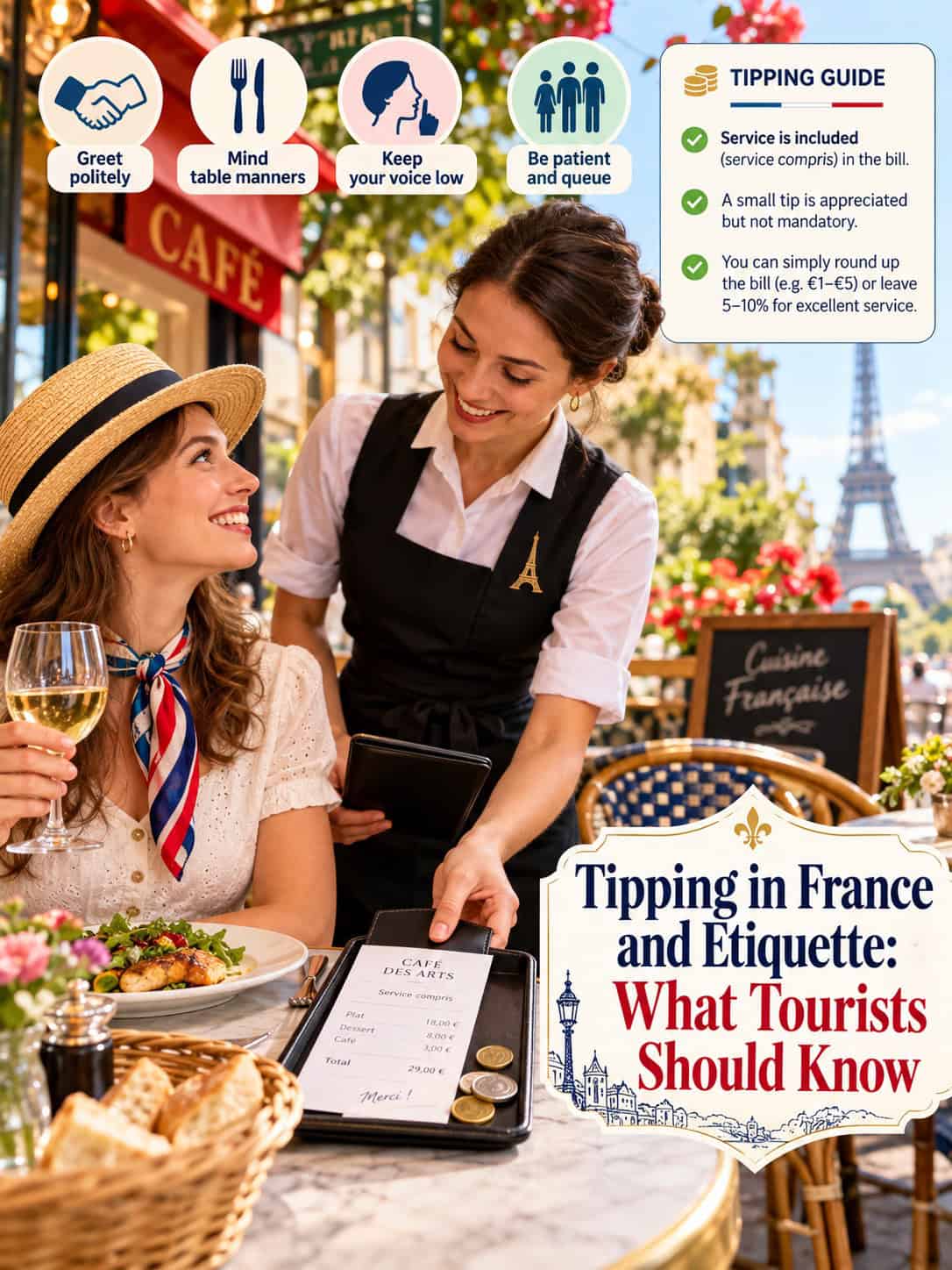
Tipping in France is optional: restaurant and café prices already include service, so visitors do not need to add the 15–20% gratuity customary in some other countries. If service is particularly good, leave a few euros or round up. This practical guide covers tipping in Paris and throughout France, hotel porters, taxis, tour guides and the French dining etiquette that matters most. For cash and cards, see our guide to money in France.
Tipping in France: What Service Compris Means
In French restaurants and bars, the displayed prices already include taxes and required service. When a service percentage is collected, the menu or receipt must say prix service compris and indicate that percentage. This is part of the price, not an extra amount to add when the bill arrives. French consumer law makes a separate pourboire voluntary: no waiter, taxi driver or other worker can require a tip.
A pourboire is a voluntary thank-you for good service. For a normal restaurant meal, paying the stated bill is entirely acceptable. For attentive service, round €47 up to €50 or leave €2–€3 in cash. There is no mandatory tip percentage in France, even in fine-dining restaurants.
How Much to Tip in France: Simple Examples
- Standard meal, nothing special: leaving nothing is perfectly acceptable.
- Good service you want to acknowledge: round up the bill or leave a few coins on the table.
- Good service, concrete example: many locals round a bill of 47 euros up to 50, or leave a few euros on the table.
- Exceptional meal at a smart restaurant: a somewhat larger gesture in cash is welcome, but still modest by North American standards.
Use euros rather than an automatic percentage: on a €25 bill, paying €25 is fine; on €47, leaving €50 is a friendly gesture; after a particularly attentive €100 dinner, an optional €5 extra is generous enough for most casual situations. None of these examples is a compulsory charge. The correct amount on the bill remains the displayed total.
How Much to Tip in France: Real Bill Examples
| Bill or service | What to pay | Optional thank-you |
|---|---|---|
| €3.50 espresso at the counter | €3.50 | None expected |
| €18 lunch | €18 | Round to €20 for notably good service |
| €47 dinner for two | €47 | Round to €50 |
| €100 restaurant bill | €100 | €5 extra for excellent service |
| €18.40 taxi ride | €18.40 | Round to €20 if you wish |
| Two suitcases carried at hotel | Service already provided | €2–€4 in total |
All extra amounts are voluntary examples, not fixed customs or compulsory percentages. Service charges are already included in displayed restaurant prices.
Tipping in France: Restaurants, Hotels, Taxis and Tours
The table summarises practical tipping habits across France, including Paris. Every amount is optional; the price of the service remains payable even when you choose not to tip.
| Situation | Usual practice | Tip |
|---|---|---|
| Sit-down restaurant | Service included in menu prices | Optional; round up or leave coins for good service |
| Café or bar (table) | Service included | Optional; a coin or two, or round up |
| Coffee standing at the counter | Pay and go | Not expected |
| Bakery, market stall, shop | Pay and go | Not expected |
| Taxi or ride-hailing | Meter or app price | Rounding up is common and appreciated, never required |
| Hotel porter | Help with bags | A small coin gesture is welcome; 1 to 2 euros per bag is the figure commonly quoted |
| Housekeeping | Daily or end-of-stay | Optional; some travelers leave a little at the end of a longer stay |
| Tour guide | Often independent guides | Optional; a small thank-you if you enjoyed it |
| Hairdresser, spa | Service often included in the price | Optional; check the price list |
Tipping in Paris and France When Paying by Card
Most French restaurant bills can be paid by card without adding any tip. If a terminal offers a gratuity screen, select zero if you do not want to leave extra; you are not declining a legal charge. For a small thank-you, leave €1–€5 in coins or notes on the table after settling the displayed bill. Some establishments can add a voluntary card tip when requested.
Tipping in France: Card Payment and Receipts
A card terminal may offer 5%, 10% or a custom tip, particularly in tourist-heavy areas. These are voluntary prompts, not a legal service charge. Check that the printed total matches the menu price and any clearly identified optional extras. You can pay the exact amount and leave no cash. If you do leave cash, placing the coins or note on the table or bill tray after payment is straightforward.
How Much to Tip Taxis in France
Taxi tips are optional. For a €18.40 meter fare, paying €20 is a reasonable thank-you, particularly if the driver helped with luggage; paying exactly €18.40 is equally acceptable. App-based rides may allow an optional in-app gratuity. Regulated airport taxi fares are not a reason to add a mandatory service percentage.
Tipping in Paris: Practical Amounts by Service
| Situation | Practical tip | Mandatory? |
|---|---|---|
| Casual French restaurant | €0; optionally round up €1–€3 | No |
| Fine dining | €0; optionally €5–€10 for exceptional service | No |
| Café table service | €0 or a few coins | No |
| Bakery and counter coffee | €0 | No |
| Taxi or ride-hail | Round up €1–€2 if satisfied | No |
| Hotel porter | €1–€2 per bag | No |
| Hotel housekeeping | €1–€2 per day if leaving a thank-you | No |
| Walking tour guide | €2–€5 per person on a paid group tour | No |
| Hair salon | Round up or €2–€5 for especially good service | No |
For a tip-based or “free” walking tour, the guide may rely on voluntary contributions as the tour’s business model. That differs from a prepaid tour with a stated price: decide a suitable payment before joining a pay-what-you-wish experience.
Do You Tip in France at a Michelin-Starred Restaurant?
There is no compulsory Michelin restaurant tipping rule. Service is already included in the bill. If staff made a special effort, an optional €5–€10 or a modest amount chosen by you is appropriate; automatic American-style gratuities are not necessary.
French Etiquette for Tourists: Start with Bonjour
If you remember only one piece of etiquette, make it this. Greet people when you enter a shop, café, bakery, boutique, hotel lobby or small restaurant, and say goodbye when you leave. In everyday French life, entering a space and starting a transaction without a greeting can come across as abrupt, even if you did not mean it that way. A friendly Bonjour before anything else, in bakeries, museums and shops alike, changes the tone of the whole exchange.
- Bonjour, madame / monsieur: the standard daytime greeting; adding madame or monsieur is polite and common.
- Bonsoir: use in the evening.
- S’il vous plaît: please.
- Merci: thank you; merci beaucoup for more warmth.
- Excusez-moi: to get attention or to pass someone.
- Au revoir / bonne journée / bonne soirée: goodbye and have a good day or evening.
Start with the greeting even when your French ends there. Following it with “Parlez-vous anglais?” (do you speak English?) is much better received than launching straight into English. Many people in tourist areas speak some English, but opening in French, however basic, signals respect. Our guide to Paris food also touches on how markets and small shops work, where the greeting habit is especially noticeable.
Cultural Etiquette in France: Vous or Tu?
French has two forms of “you”: the formal vous and the informal tu. As a visitor, use vous with shop staff, waiters, hotel staff and anyone you do not know. If someone offers tu, you can follow their lead. Switching to tu without being invited can sound too familiar, although foreigners are usually forgiven.
Greeting Friends and Hosts
Among friends and acquaintances, many French people greet with la bise, a light kiss on the cheek, while in business or first meetings a handshake is the safer choice. The number of kisses and which side you start with vary by region and by family. If you are invited to someone’s home, wait to see what your host does and follow it, and bring a small gift such as flowers or something sweet rather than arriving empty-handed.
French Dining Etiquette: Restaurants and Cafés
French meals often move at a relaxed pace, and staff may wait for you to request the bill. Begin with bonjour, wait for a table in a sit-down restaurant, understand the difference between la carte and a set menu, and request l’addition when ready. None of these customs creates an obligation to tip.
Timing and Seating
- Meal hours matter. Traditional restaurants often serve lunch and dinner in set windows, and many kitchens close between roughly 2:30 pm and 7 pm. Brasseries and cafés in busy areas may serve food through the day, but do not count on it. Check the hours posted at the door.
- Wait to be seated in sit-down restaurants unless a sign says otherwise. Say bonjour, say how many you are, and the staff will show you a table.
- Reserve ahead for dinner at popular places, especially in major cities and on weekends. Our Paris travel guide covers neighborhoods where booking is worth it.
Menu, Formule and Plat du Jour
Many restaurants offer a fixed-price menu or a formule (for example starter plus main, or main plus dessert), which is often better value than ordering à la carte, particularly at lunch. A plat du jour is the dish of the day. The word menu in France often means the fixed-price set meal; the list of everything you can order is usually the carte. Ask if you are unsure.
French Dining Etiquette: Bread, Tap Water and Drinks
When eating a meal in a French restaurant, ordinary bread and a carafe of tap water are included in the displayed dining price. Ask for une carafe d’eau, s’il vous plaît rather than bottled water if you want the free option. Bottled mineral and sparkling water cost extra. The meal-service rule does not mean a café must supply an unlimited free jug when you only order coffee.
Tipping in French Restaurants: Asking for the Bill
Staff generally will not rush you or bring the bill uninvited, which can feel like neglect if you are used to quick turnover. When you want to leave, catch the waiter’s eye and say L’addition, s’il vous plaît. Splitting a bill is possible but can be slower; mention it before ordering or when asking for the bill, and be prepared for staff to prefer separate card payments to be organized clearly. If you are on a tight schedule, say so early.
Table Manners
- Many French diners keep their hands above the table rather than in the lap (a habit, not a rule), and use bread to mop up sauce on the side of the plate if you wish.
- Do not ask for major changes to a dish; small allergy or dietary notes are fine, but heavy customizing is less common than in some countries.
- Phones stay in pockets or face down; loud calls at the table are frowned upon.
- Finishing a meal is not a race. Coffee is usually ordered after dessert, not with it.
French Dining Etiquette: Useful Phrases for Tourists
| French phrase | English meaning | When to say it |
|---|---|---|
| Bonjour, madame / monsieur | Hello | Entering a bakery or restaurant |
| Une table pour deux, s’il vous plaît | A table for two, please | Asking to be seated |
| La carte, s’il vous plaît | The menu / list of dishes, please | Ordering food |
| Une carafe d’eau, s’il vous plaît | A jug of tap water, please | With a restaurant meal |
| L’addition, s’il vous plaît | The bill, please | Ready to pay |
| On peut payer séparément ? | Can we pay separately? | Splitting a restaurant bill |
| C’était délicieux, merci | It was delicious, thank you | Complimenting your meal |
| Au revoir, bonne journée | Goodbye, have a nice day | Leaving a shop or café |
Say bonjour or bonsoir before a request. It is a courtesy, not a special phrase reserved for expensive establishments.
Tipping in Paris Cafés: Counter vs Terrace
Cafés are a pillar of French daily life, and they have their own rhythm. You can sit for a long time over one drink; there is no obligation to order more, and staff will usually not hurry you outside very busy periods. Choose where you sit, because the position can affect the price; cafés are required to display their price lists, usually with separate counter and table or terrace prices.
- Counter versus table: drinks are cheaper standing at the bar (au comptoir) than sitting at a table, and often cheaper inside than on a terrace; the gap can be large for the same coffee. Price lists must be posted, so look before you sit.
- Order by name: un café normally means a small, strong espresso. For milk, ask for un café crème or un cappuccino, and for a long coffee, un allongé.
- Pay when you are ready: in many cafés you pay at the end, but at some you pay on each order. Follow what the people around you do, or ask.
- Terraces: the best seats face the street and the staff may not rush you; this is part of what you are paying for.
Breakfast at a café or bakery tends to be light: coffee and a pastry or a slice of bread with butter and jam. Heavy cooked breakfasts are mainly a hotel thing. A bakery visit also needs a quick bonjour, and you generally pay at the counter without any tip.
Cultural Etiquette in France: Dress and Behaviour
France has a reputation for style, but you do not need to dress up. What helps is looking put together rather than formal. Clean, simple clothes in neutral colors blend in easily, and comfortable shoes are essential for cobbled streets and long museum days. Our packing guide goes deeper on seasonal clothing.
Dress Guidelines
- City streets and restaurants: smart-casual is the safe default. Beachwear, bare chests and swimwear belong at the beach or pool, not in towns, shops or restaurants.
- Fine dining: some upscale restaurants expect a more polished look; if in doubt, check when you reserve.
- Churches and religious sites: cover shoulders and knees as a courtesy; major cathedrals such as Notre-Dame ask for it, and sleeveless tops and short shorts may be refused. Remove hats inside churches.
- Markets and countryside: practical and casual is fine.
Behavior in Public
- Keep your voice down in restaurants, on public transport and in hotel corridors. Loud conversation draws more attention in France than in some other places.
- Public transport: let people off before boarding, offer seats to people who need them and keep bags off seats. On escalators, stand on one side so others can pass.
- Queues: respect them; pushing in causes real annoyance. At busy sights, a ticket booked in advance saves time.
- Smoking: check where it is allowed before lighting up; rules vary by venue and space.
- Photography: check signs in museums and be discreet in churches and with strangers.
- Dogs: well-behaved dogs are accepted in many cafés and some restaurants, which may surprise you.
Shops and Services
Shops often have set opening hours that include a midday closure in smaller towns, and many are closed on Sundays or on certain weekdays outside tourist areas. Check opening hours before making plans, particularly around public holidays. In markets, ask before touching produce, and let the seller choose or hand it to you if that is the local style. Bargaining is not customary in normal shops, although a polite request can work at flea markets and antique fairs.
Tipping in France: Common Tourist Mistakes
- Skipping the greeting. This is the biggest single error. Say bonjour first.
- Over-tipping on autopilot. Adding a large amount because that is the rule at home is not needed and not expected.
- Expecting the bill unprompted. Ask for it.
- Sitting before checking prices. Terrace and table prices can be higher than the counter.
- Expecting continuous service in the afternoon. Many kitchens close between lunch and dinner.
- Being too loud. Moderate volume goes a long way.
- Taking everything personally. A brisk manner is often just efficiency, not rudeness.
Tipping in France vs the United States
| Question | France | United States (common custom) |
|---|---|---|
| Restaurant service in displayed price | Included | Often a separate gratuity is customary |
| Standard 15–20% tip | Not expected | Common in sit-down service |
| Tip required by law | No | Not generally a legal duty, except valid service charges |
| How to thank attentive staff | Round up or leave a few euros | Often percentage-based |
| Bill brought automatically | Often only when requested | More likely at end of meal |
The easiest adjustment for North American visitors is to stop calculating a percentage automatically. In France, the listed price is what you owe.
Staying Safe and Respectful
Good manners also support good safety habits. In crowded tourist areas, keep valuables secure and be wary of unsolicited offers; our guide to whether France is safe for tourists covers scams and precautions in detail. Treat street petitions, friendship bracelets and unrequested help with a polite but firm non, merci. If you need help, police and emergency numbers are listed on official sites, so check them on Service-Public.fr before you travel. For official advice, see the French foreign ministry and your own government’s travel pages; for general trip ideas, France.fr is the national tourism site.
Tipping in France: Frequently Asked Questions
Do You Tip in France at Restaurants?
No. Service is normally included in menu prices (service compris), so a tip is optional. A small extra for good service, such as rounding up or leaving some coins, is appreciated but not required.
Is It Rude Not to Tip in France?
Not after an ordinary meal. Staff are paid a regular wage and the service is already in the price. Leaving a little for especially good service is a kind gesture, not an obligation.
Can You Tip by Card in France?
Often the terminal will not offer a tip option. If you want to leave something, small change on the table is the usual method.
How should I greet staff in shops and restaurants?
Say bonjour (or bonsoir in the evening) when you enter and goodbye when you leave. Using madame or monsieur is polite. It matters more than most travelers expect.
Is Tap Water Free in French Restaurants?
A jug of tap water, une carafe d’eau, is normally available on request with a meal. Ask for it by name if you do not want bottled water.
Why do coffees cost more at a table than at the counter?
In many cafés, the price list differs by location: standing at the bar is usually cheaper than sitting inside or on the terrace. Look at the posted prices before you sit.
What Should Tourists Wear in France?
Smart-casual works almost everywhere. Avoid beachwear in towns and restaurants, cover shoulders in churches, and bring comfortable shoes for walking.
How much should you tip in Paris restaurants?
You can leave nothing. For especially attentive service, round a €47 bill to €50 or add €2–€3. Service is already included in the restaurant price.
Does service compris mean a 15% tip is included?
Service compris means required service is included in the displayed price. It is not an instruction to calculate and add another 15% gratuity. A pourboire is separate and optional.
Do you tip at a Paris café?
No tip is required, whether you drink coffee at a table or at the counter. Leaving spare change after table service is entirely optional.
Do you tip hotel housekeeping in France?
Not as a rule. You can leave €1–€2 per day if you want to thank the housekeeping team.
Do you tip taxi drivers in France?
No. Pay the metered or app fare, and round up by €1–€2 only if you wish.
Can a French restaurant demand a tip?
No. A voluntary tip cannot be demanded. The service component of the meal must already be reflected in the stated price.
Do tourists tip guides in France?
A paid tour guide does not require an additional tip. An optional few euros is appreciated for a good group tour. Pay-what-you-wish tours are different because contributions are their principal payment model.
Is it better to tip in euros or by card?
Euro coins and notes are the simplest way to leave a voluntary thank-you, although some card terminals also offer optional gratuity.
Is bread included in French restaurant prices?
Yes, ordinary bread served with a sit-down restaurant meal is included, as is a carafe of drinking tap water on request.
Should I tip in southern France as well as Paris?
The same national principle applies throughout France: tipping is optional, and restaurant service is included in the published price.
Tipping in France: Final Advice
Tipping in France is entirely voluntary: pay the amount on your restaurant bill, and add a couple of euros only when you want to thank someone for especially good service. In Paris as elsewhere, you do not need to add a standard 15–20%. The strongest everyday etiquette is simple: say bonjour before asking for something, use vous with strangers and ask for l’addition when ready to leave.
Pingback: Money in France: Euros, ATMs, Cards and Daily Costs.
Pingback: French Food Guide: 15 Traditional Dishes by Region
Pingback: France Public Holidays and Festival Calendar