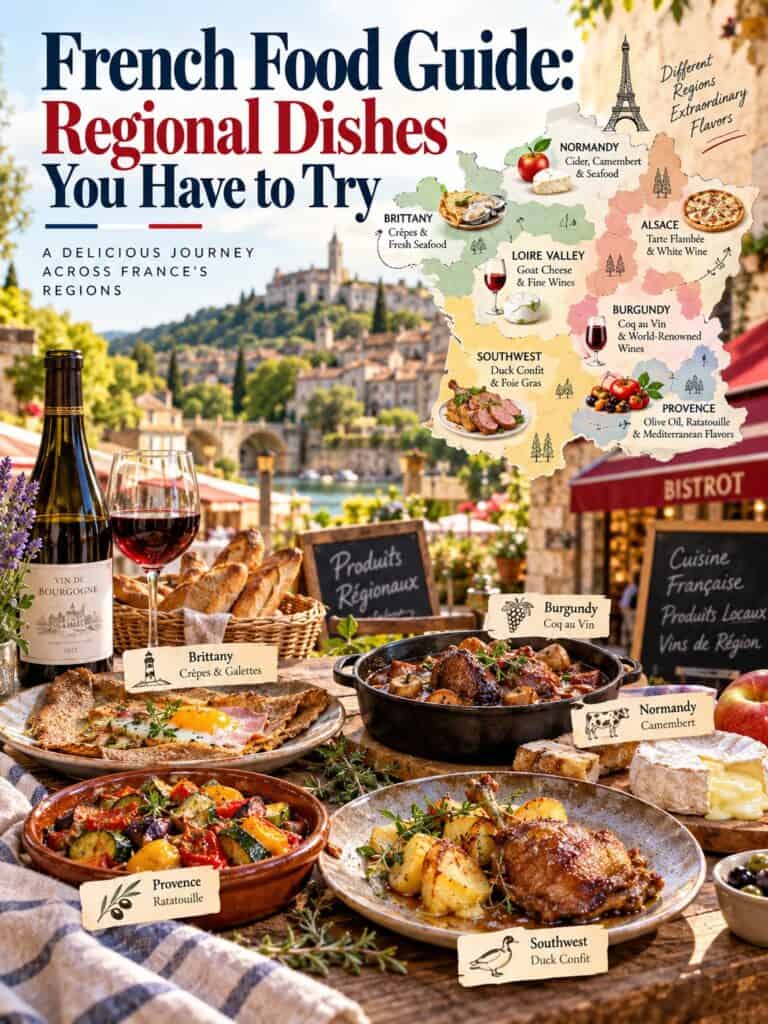
French food is best understood region by region. French cuisine is really a collection of local cuisines shaped by climate, livestock, rivers and vineyards, and a dish that defines one corner of the country may be barely known a few hundred miles away. If you only want the short answer, the French dishes most visitors should try are boeuf bourguignon, cassoulet, choucroute, bouillabaisse, tarte flambée and a buckwheat galette, each best eaten in its home region.
This guide lists 15 traditional French dishes with their region, main ingredients and the best place to try them, then goes region by region with practical tips for ordering well and avoiding tourist-menu traps. It is about eating as a visitor, not cooking: there are no recipes here.
15 French Dishes to Try
| Dish | Region | Key ingredients | Where to try it |
|---|---|---|---|
| Boeuf bourguignon | Burgundy | Beef, red wine, onions, mushrooms, bacon | Dijon, Beaune and Burgundy village bistros |
| Coq au vin | Burgundy | Chicken, red wine, onions, mushrooms, bacon | Burgundy and traditional bistros nationwide |
| Escargots de Bourgogne | Burgundy | Snails, garlic-parsley butter | Dijon and Beaune, as a starter |
| Cassoulet | Languedoc (Castelnaudary, Toulouse, Carcassonne) | White beans, pork, sausage, often duck | The southwest in autumn and winter |
| Choucroute garnie | Alsace | Sauerkraut, sausages, pork cuts, potatoes | A winstub in Strasbourg or Colmar |
| Tarte flambée | Alsace | Thin crust, fromage blanc, onions, bacon | Alsace taverns and winstubs |
| Bouillabaisse | Marseille, Provence | Mediterranean rockfish, saffron broth, rouille, croutons | Marseille, ordered in advance |
| Ratatouille | Provence | Aubergine, courgette, peppers, tomato, olive oil | Provence markets and countryside lunches |
| Salade niçoise | Nice | Tuna, egg, green beans, tomatoes, olives, anchovies | Nice, in summer |
| Quenelles lyonnaises | Lyon | Light pike dumplings, often with Nantua sauce | A traditional Lyon bouchon |
| Confit de canard | Southwest, Dordogne | Duck leg preserved and slow cooked in its own fat | Sarlat and Dordogne villages |
| Galette bretonne | Brittany | Buckwheat crepe with ham, cheese and egg | A crêperie in Brittany, with cider |
| Moules à la normande | Normandy | Mussels, cream, cider, apple | Normandy coast |
| Raclette | Savoie and the Alps | Melted cheese, potatoes, cured meats | Alpine towns in cold weather |
| Soupe à l’oignon | Paris | Onions, stock, bread, melted cheese | A Paris bistro |
Prices vary widely by region and restaurant, so none are quoted here except for bouillabaisse, which is the one dish where the cost surprises people (see the Provence section below).
How French Regional Cooking Works
Three ideas explain most of what you will see on menus. First, fat and base ingredients follow geography: butter and cream dominate in the north and in Normandy, olive oil and herbs in Provence, and duck and goose fat in the southwest. Second, wine and food grew up together, so the local dish is usually designed to suit the local bottle. Third, many iconic dishes began as peasant cooking that used cheaper cuts, preserved meats and whatever the season offered. That is why so many classics are slow braises, stews and preserved foods rather than fussy plates.
Menus also carry labels worth recognizing. Fait maison is a legal mention: a restaurant that uses it must prepare the dish on the premises from raw ingredients, though a few items such as bread, cheese, wine and some processed products are allowed. Plat du jour is the daily special, and formule or menu is a set-price combination of two or three courses. Appellations and quality labels exist for many cheeses, wines and some meats. They signal a protected origin and method, though they do not guarantee that a particular restaurant is good.
Traditional French Food by Region
French Food in Paris and Ile-de-France
French food in the capital is less a regional kitchen than a stage for the whole country, but a few things are truly Parisian: the bistro classics, the daily market and the bakery habit. Steak frites, onion soup, a ham-and-butter baguette sandwich and a flaky croissant are the standard cravings. For neighborhood-by-neighborhood advice, our Paris food guide covers bistros, markets and pastries, and the Paris travel guide puts them in the wider city plan.
French Food in Lyon and the Rhône Valley
Lyon has long been called the gastronomic capital of France, and its traditional restaurants, known as bouchons, serve hearty, meat-forward cooking. Look for quenelles (light dumplings traditionally made from pike and often served with a creamy Nantua sauce), salade lyonnaise (bitter greens with bacon, a poached egg and croutons), andouillette (a sausage made from pork intestines, with a strong flavor that is an acquired taste) and the vivid pink almond-praline tart, tarte aux pralines. Be honest with yourself about offal: if you do not enjoy strong, rustic flavors, ask what a dish contains before ordering. Our Lyon travel guide explains the old town and its covered passages, and the guide to where to stay in Lyon helps you choose a base within walking distance of the best tables.
French Food in Alsace: Choucroute and Tarte Flambée
Alsace sits on the German border and its table shows it. The signature dish is choucroute garnie, sauerkraut served with a platter of sausages and pork cuts. Tarte flambée (also called flammekueche) is a thin crust topped with fromage blanc, onions and bacon. Baeckeoffe is a slow-baked casserole of pork, lamb, beef and sliced potatoes, cooked in white wine. Most Alsace wine is white and labeled by grape, so ordering is easier than elsewhere in France: Riesling suits choucroute and fish, while the more perfumed Gewurztraminer suits spiced or sauced dishes. Plan around the region with our Strasbourg and Alsace Wine Route guide and the Colmar travel guide.
French Food in Burgundy: Boeuf Bourguignon and Coq au Vin
Burgundy is home to boeuf bourguignon, beef braised in red wine with onions, mushrooms and bacon, and coq au vin, the same idea applied to chicken. Other regional markers are escargots baked in garlic-parsley butter, jambon persillé (ham set in parsley aspic), oeufs en meurette (eggs poached in a red wine sauce) and Dijon mustard, a regional institution. Époisses, from the Côte-d’Or, is famously pungent, so expect to smell it before you see it. The local reds come from Pinot Noir and the whites from Chardonnay. Our Burgundy travel guide covers Dijon, Beaune and the wine villages.
French Food in Champagne
The French food of Champagne is lighter and more modest than the fame of its wine suggests. Think of ham, regional charcuterie, simple river fish, soft bloomed-rind cheeses and small biscuits designed to be dipped in sparkling wine. Many visitors treat the region as a wine destination first, and cellar visits are the highlight. Book ahead, because most houses and growers offer tours and tastings by appointment, and about two weeks in advance is a sensible lead time. The Champagne region visitor guide explains how to plan Reims and Épernay.
French Food in the Southwest: Cassoulet, Duck and the Dordogne
This is duck and goose country. Expect confit de canard (duck leg preserved and slow cooked in its own fat), magret (duck breast, typically cooked pink), foie gras, walnuts, ceps in season and dishes with black Périgord truffle. In Sarlat, potatoes fried in duck fat (pommes sarladaises) are the classic side for confit. In Bordeaux the classic dessert is the small caramelized cannelé. Cassoulet, a slow-cooked white bean casserole with sausage, pork and often duck, belongs to Languedoc (Castelnaudary, Toulouse and Carcassonne all claim it) and is heavy, so plan a light evening afterward. For planning, see the Dordogne travel guide and the Bordeaux travel guide. Foie gras is a divisive product for ethical reasons, so decide in advance whether you want it. Plenty of menus offer duck without it.
French Food in Provence and the Mediterranean Coast
Here French food turns to olive oil, tomatoes, garlic, herbs and fish. Dishes to look for include bouillabaisse (a Marseille fish stew traditionally served with croutons and a garlicky rouille sauce), ratatouille (stewed summer vegetables), tapenade (olive paste), salade niçoise (tuna, egg, green beans, tomatoes and olives) and pissaladière (an onion and anchovy tart). Rosé is the regional default and pairs easily with this food.
Authentic bouillabaisse is an event rather than a quick lunch. A charter drawn up by Marseille restaurateurs in 1980 sets standards for the dish, including several local Mediterranean rockfish, and restaurants that follow it commonly ask for about 24 hours’ notice and sometimes a minimum of two diners. Prices are not universal: figures commonly quoted range from roughly 65 euros per person at the low end to well over 100 euros at top restaurants, so confirm the price and the booking rules when you reserve. Our Provence travel guide covers the villages and markets, and the French Riviera itinerary covers Nice and the coast.
French Food in Brittany and Normandy
The Atlantic and Channel coasts give you oysters, mussels, scallops and langoustines, along with butter-rich cooking. Brittany is the home of the buckwheat galette, a savory crêpe often filled with ham, cheese and egg, and of sweet wheat crêpes, usually served with cider. Normandy contributes moules à la normande, apples, cider, Calvados and cheeses such as Camembert de Normandie, Pont-l’Évêque, Livarot and Neufchâtel. The shorthand for the region is cream, Camembert, cider and Calvados. Seafood is the star of French food on this coast, and platters are best where the sea is close and the turnover is high. See Normandy vs Brittany to choose a coast.
More Specialities Worth a Detour
- Raclette and fondue (Savoie and the Alps): melted cheese with potatoes and cured meats, best in cold weather.
- Aligot (Aubrac): mashed potatoes whipped with fresh cheese into a stretchy, rich dish.
- Crêpes Suzette and far breton: classic desserts that show up in the west and in traditional restaurants nationwide.
Regional French Food at a Glance
| Region | Dish to try | Style | Typical pairing |
|---|---|---|---|
| Lyon area | Quenelles, salade lyonnaise | Rich, meat-forward | Beaujolais or Rhône reds |
| Alsace | Choucroute, tarte flambée | Hearty, German-influenced | Riesling, Pinot Gris |
| Burgundy | Boeuf bourguignon, escargots | Braised, wine-based | Pinot Noir, Chardonnay |
| Champagne | Charcuterie, soft cheeses | Light, simple | Champagne |
| Southwest | Confit de canard, magret | Duck, goose, walnuts | Bordeaux and Southwest reds |
| Provence | Bouillabaisse, ratatouille | Olive oil, herbs, seafood | Rosé, light whites |
| Brittany | Buckwheat galette, oysters | Seafood, crêpes | Cider, Muscadet-style whites |
| Normandy | Moules à la normande, Camembert | Butter, cream, apples | Cider, Calvados |
| Languedoc | Cassoulet | Slow-cooked beans and meats | Local reds |
French Food Menu Glossary and Allergens
| French term | What it means |
|---|---|
| Entrée | Starter (not the main course, as in the US) |
| Plat | Main course |
| Plat du jour | Dish of the day |
| Formule / menu | Set-price combination of two or three courses |
| Fait maison | Prepared on the premises from raw ingredients |
| Saignant / à point / bien cuit | Rare / medium / well done |
| Une carafe d’eau | Free tap water at the table |
| Sans viande / sans gluten | Without meat / without gluten |
| Je suis allergique à… | I am allergic to… |
Restaurants in France are required to be able to tell you which of the 14 main allergens a dish contains, including gluten, milk, eggs, fish, shellfish, nuts, celery, mustard and sulphites. Ask Y a-t-il du lait, des œufs ou du gluten dans ce plat ? (Does this dish contain milk, eggs or gluten?). Classic dishes often hide them: sauces and stocks usually contain butter, cream or flour, quenelles contain eggs and flour, tarte flambée contains gluten and dairy, and bouillabaisse contains fish and shellfish. Tell the restaurant at booking time, because a rustic regional kitchen may need notice to adapt a dish.
Cheese, Bread and Pastry in French Food
Cheese is a pillar of French food, and France has hundreds of cheeses, usually grouped into families: fresh, soft with a bloomed rind, washed rind, pressed, blue and goat. If you are unsure, ask the person behind the counter for a mixed selection at different strengths and for guidance on ripeness. A good fromager is happy to advise. At a restaurant, the cheese course comes before dessert and is typically a plate or a trolley of choices.
Bread is part of every meal. The traditional baguette is baked and bought fresh, often more than once a day, and a bakery with a short line of locals is usually a safe bet. For breakfast, a croissant is flaky and buttery, a pain au chocolat contains chocolate batons, and many regions have sweet specialties you will not find elsewhere. Eating pastry standing up with a coffee is perfectly normal.
How to Eat Well and Avoid the Traps With French Food
- Eat the lunch menu. A formule is commonly offered at lunch and is often among the best values. The plat du jour is usually written on a chalkboard outside. Check the posted menu rather than assuming.
- Match the season. Short menus that change with the calendar tend to signal fresh cooking. Very long menus with photos often signal reheated food.
- Look away from the monuments. A restaurant directly opposite a major sight is more likely to cater to passing trade. Walk two or three streets back.
- Order the local specialty in its home region. Cassoulet in the southwest and choucroute in Alsace are usually better and more authentic than versions in distant cities.
- Learn the meal rhythm. Lunch is typically served from about noon to 2 pm and dinner from about 7 pm. In small towns the kitchen often closes in between, so arriving at 3 pm and expecting a full meal rarely works. Book dinner, especially on weekends.
- Ask for tap water. Une carafe d’eau is the usual request.
- Know the tipping rule. Service is already included in menu prices, and a small extra amount is optional. See our guide to tipping in France.
Dietary Needs
Traditional French food relies heavily on meat, butter, cream and eggs, and can hide ingredients in sauces and stocks. Vegetarian and vegan options have grown, especially in larger cities, but in rural areas they can be limited. Learn sans viande (without meat) and je suis allergique à (I am allergic to), and tell the restaurant when you book.
Drinks to Pair With French Food
Wine is the natural companion of French food, and the simplest rule is to drink what the region produces. A house wine by the glass or carafe is usually a sound choice at a casual restaurant. Cider is the drink of Brittany and Normandy, and beer is part of the Alsace tradition. For appellations and tasting visits, see our guide to the best wine regions in France.
Building a French Food Itinerary
Combining regions by train or car is easier than it looks when you plan French food stops by region. A compact east-of-France loop might link Alsace, Burgundy and Lyon, a western route could connect Bordeaux with the Dordogne, and Champagne is an easy add-on to a Paris stay. Allow time between meals: a traditional three-course lunch with wine can last a couple of hours, and trying to schedule too many tastings in one day blunts the experience. Our 2-week France itinerary shows how regions fit together, and the best time to visit France guide helps you match dishes to seasons.
Frequently Asked Questions About French Food
What food is France famous for?
France is famous for its regional specialities rather than one national dish: boeuf bourguignon from Burgundy, cassoulet from Languedoc, bouillabaisse from Marseille and choucroute from Alsace, along with cheese, bread, pastry and wine.
What should I eat in France for the first time?
Start with the classics that suit most tastes: a croissant or pain au chocolat for breakfast, an onion soup or steak frites in a bistro, a buckwheat galette in Brittany and a cheese course. Then eat each region’s own dish where it was born.
Which French dishes are vegetarian?
Few classics are vegetarian by default, but ratatouille, gratin dauphinois, omelettes, cheese dishes such as raclette and fondue, and tarte flambée without bacon (sans lardons) usually work. Check stocks and sauces, since onion soup is often made with meat stock.
What is the most famous regional dish in France?
There is no single answer, since each region has its own icon. Boeuf bourguignon, cassoulet, bouillabaisse and choucroute are among the best known.
Which French city is best for food?
Lyon has a long reputation as the food capital, and Paris offers the widest range. Bordeaux and Strasbourg are also strong choices for regional cooking and wine.
Do I need to tip in French restaurants?
Service is already included in menu prices. Many diners leave a small extra amount for good service, but it is optional.
When are restaurants open in France?
Many serve lunch and dinner in set windows and some close one or two days a week, so check hours and reserve ahead, especially for dinner and on weekends.
Bottom Line
Choose the region first and the dishes will follow: braises in Burgundy, sauerkraut platters in Alsace, duck in the southwest, fish stews on the Mediterranean and crêpes with cider in the west. Eat the local specialty where it was born, take the lunch menu, walk away from the tourist squares and let the local wine guide your pairing. The best meals usually come from asking the person who runs the place what they recommend today.
Pingback: Best Hotels in Lyon: Where to Stay by Neighborhood.
Pingback: Paris to Provence Road Trip: 7-Day Itinerary & Tips.
Pingback: Best Wine Regions in France: Bordeaux, Burgundy, Champagne.
Pingback: Burgundy Travel Guide: Dijon, Beaune and Wine Villages.
Pingback: Annecy Travel Guide: Lake, Old Town and Mountains.
Pingback: Bordeaux Travel Guide: Wine, Old Town, Day Trips.
Pingback: Things to Do in Lyon: Top 10, Traboules and Bouchons