This France visa guide explains the one question that decides everything else: do you need a France visa at all, or can you simply fly in? France is part of the Schengen Area, so its entry rules are shared with 28 other European countries, and a French short-stay visa is really a Schengen visa. Below you will find how the 90/180 rule works, how to tell which side of the line you are on, how the France visa application runs from form to passport collection, and what to make of the new border systems (EES and ETIAS). Rules and fees move, so treat this as a map and confirm details on the official portals before you book anything non-refundable.
Also available in: 中文 · 한국어 · 日本語
Do I Need a Visa for France? Quick Answer
| Your situation | What it means |
|---|---|
| Your passport is from a visa-exempt country | You can enter for up to 90 days in any 180-day period without a visa. Some travelers will need ETIAS once it starts, which has no date yet. |
| Your passport is not visa-exempt | You must apply for a short-stay Schengen visa at a French consulate or its outsourced center before you travel. |
| You want to stay more than 90 days | A short-stay visa or visa-free entry will not cover it. You need a long-stay visa, which is a separate procedure. |
| You are not sure | Check your nationality on the official France-Visas portal (france-visas.gouv.fr), which tells you what applies to your passport. |
France Visa Requirements: Visa-Free or Visa Required
Every foreign visitor falls into one of two groups. Citizens of a number of countries, including the United States, Canada, Australia, Japan and the United Kingdom, can enter the Schengen Area for short stays without a visa. Citizens of other countries must apply for a short-stay Schengen visa at a French embassy or consulate before leaving home. Which group you belong to depends only on your passport, not on where you live or how often you travel. We deliberately do not list every nationality here: the lists are revised, and a stale list is worse than none.
Both groups share the same ceiling. A short stay in Schengen, whether on a visa or visa-free, cannot exceed 90 days within any 180-day period. The visa does not extend that limit; it only grants permission to arrive.
How the 90/180 Rule Really Works
The 180-day period is not a calendar block that resets. It is a rolling window: on any given day, officers look back 180 days and count the days you spent inside the Schengen Area. If that count has reached 90, you cannot enter, or you must leave. Both the day you arrive and the day you leave count as full days. Days in all Schengen countries are pooled together, so a month in Spain and a month in Germany leave you with roughly one month for France.
Planning a long trip around the window
- Count backward, not forward. Before a second trip, add up every Schengen day in the previous 180 days, not just those in the current calendar half-year.
- Non-Schengen neighbors do not count. Time in the UK or Ireland, for example, does not use up your allowance, but check each country’s own entry rules before relying on that.
- Overstays are costly. Even one day over can lead to fines, removal or a re-entry ban, and the digital records make overstays much easier for border officers to see.
- A trip longer than 90 days is a different application. Staying beyond three months in France needs a long-stay visa, which is not covered here.
Travelers who want to see France for several weeks usually fit comfortably inside the limit. A classic route like the one in our France 10-day itinerary uses about a ninth of the allowance.
Passport and Entry Basics for Visa-Free Visitors
Even without a visa, you need to meet entry conditions. The standard requirement is a passport valid for at least three months beyond your planned departure from the Schengen Area and issued within the previous ten years. Border officers may also ask for proof of the purpose of your trip, accommodation, a return or onward ticket, and enough money to cover your stay. Carrying a printed or saved hotel booking and a return ticket costs nothing and answers most questions. If you are unsure how much cash and cards to prepare, our guide to money in France covers ATMs and typical daily costs.
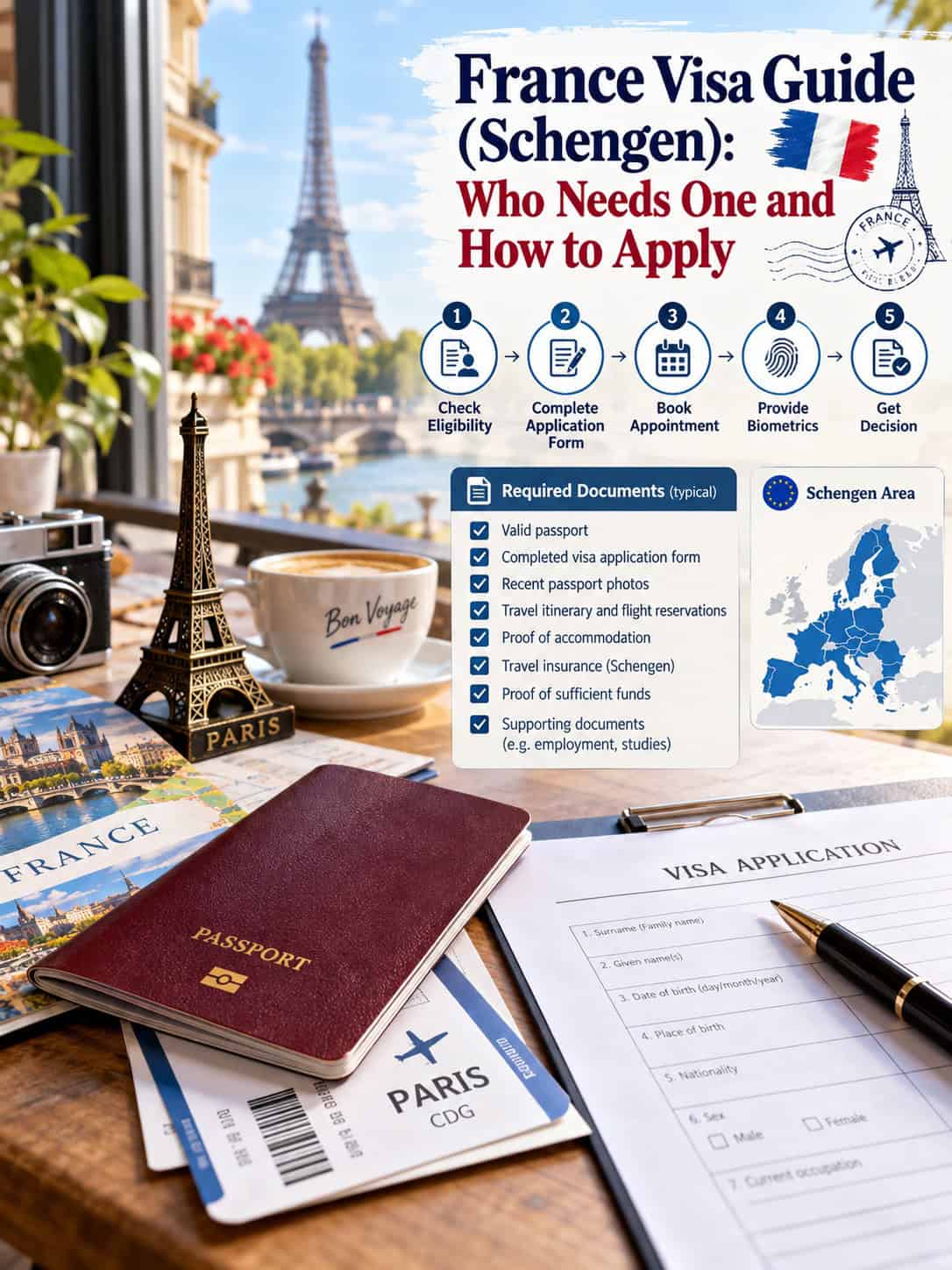
France Visa Application: Step-by-Step Process
The process is standardized across Schengen, but each French consulate, and the outside service provider it works with, adds local details. Expect the following sequence.
- Confirm the visa type. Tourism, family visits, business meetings, short courses and conferences all fall under the short-stay “uniform Schengen” visa, valid for up to 90 days in 180.
- Find the right office. Applications are lodged in your country of residence, at the French consulate or at the outsourced center that handles it for France. The France-Visas portal shows which one applies to you.
- Complete the online form. The France-Visas portal generates the application form, which you print, sign and bring with you.
- Book an appointment. Slots can be scarce in busy seasons, so book early.
- Attend in person. You submit documents and give biometrics (fingerprints and a photo). Originals plus a photocopy of each document are normally requested.
- Pay the fees. There is the visa fee itself and, where an outsourced center is used, a separate service fee.
- Wait for the decision, then collect your passport. The visa is a sticker in your passport, and some centers offer courier return for an extra charge.
France Visa Processing Time and When to Apply
Applications are generally accepted from six months before travel and no later than 15 days before. A decision is normally taken within about 15 days, though the consulate can extend that in individual cases. Do not apply at the last minute, because appointment availability, not processing, is often the real bottleneck. A sensible target is to apply six to eight weeks ahead, and not to buy non-refundable flights before the visa is in your passport.
France Visa Fees
The standard Schengen visa fee has been 90 euros for adults since June 2024, with a reduced fee of 45 euros for children aged 6 to under 12 and no fee for children under 6. Some nationalities have reduced or waived fees under EU agreements. An outsourced center typically adds its own service fee, and optional extras such as photocopies, photos or courier delivery cost more. Fees can change, so use the figure shown on your consulate’s page rather than any article, including this one.
France Visa Documents Checklist
| Document | Purpose | Where to confirm |
|---|---|---|
| Passport valid at least three months after departure, with blank pages | Proves identity and eligibility to travel | Your consulate’s checklist |
| Signed France-Visas application form | Formal application for the short-stay visa | Generated on the France-Visas portal |
| Recent passport-style photos | Identification, to the Schengen specification | Your consulate’s photo guidance |
| Travel medical insurance for the whole Schengen Area, at least 30,000 euros of cover | Covers medical emergencies and repatriation | Your consulate’s checklist |
| Round-trip or onward reservation and proof of accommodation for the whole stay | Shows your plans and dates | Your consulate’s checklist |
| Proof of means of subsistence and ties to your home country (bank statements, employment or study documents) | Shows you can fund the trip and will return | Your consulate’s checklist |
Consulates publish their own checklists and may ask for more. Follow your local list exactly, since missing documents are a common reason for delays and refusals. Keep your itinerary consistent with your paperwork: a plausible plan that matches your bookings reads better than a vague one, and our guide on the best time to visit France can help you choose dates that make sense for what you intend to see.
If Your France Visa Is Refused
A refusal comes with a written notice stating the reason. For a short-stay visa refused since 1 January 2023, the first step is an administrative appeal to the sous-directeur des visas in Nantes (a letter in French, signed, sent by registered mail), and it must be filed within 30 days of the refusal notice. If that appeal is rejected, the next step is the Nantes administrative court. Read the refusal notice carefully, since the instructions printed on it take priority over any general summary. Often a clean new application that addresses the stated reason (unclear funds, weak ties to your home country, incomplete insurance) is faster than an appeal.
EES and ETIAS: What Is Changing at the Border
Two EU systems are reshaping the border experience, and they are often confused.
EES (Entry/Exit System)
The Entry/Exit System replaces manual passport stamps with a digital record. It was introduced in phases from October 2025 and became fully operational at all Schengen external borders on 10 April 2026. For non-EU visitors it means your facial image, fingerprints and passport data are captured, typically at your first crossing, and later crossings are faster. It applies to visa-free visitors and visa holders alike, and it makes the 90/180 count automatic. The rollout has caused long queues at some airports, so leave generous connection times, especially when arriving at a large airport such as Paris-Charles de Gaulle.
ETIAS (travel authorization)
ETIAS is not a visa. It is a planned online authorization for visa-free travelers, similar in spirit to the US ESTA, with a fee of 20 euros and exemptions for younger and older applicants. It is not yet in operation. The European Commission previously pointed to the last quarter of 2026, but that window has been removed from the official EU ETIAS page, no start date has been announced, and the EU says it will give notice several months before launch. Reports point to 2027, so treat any date as provisional. Be cautious of websites that sell ETIAS applications now, since none is currently required.
Practical Tips for Entry Day
- Keep your passport, return ticket and accommodation details together and easy to reach in your hand luggage.
- Expect the biometric kiosk or booth at your first Schengen entry if EES applies to you, and allow extra time on arrival.
- If you transit another Schengen country first, your entry checks happen there, and you may travel to France without further border control.
- Buy insurance even if it is not mandatory for you. It is required for visa applicants, and it is sensible for everyone.
Set up connectivity before you land if you want maps and booking confirmations at the border; our guide to France SIM cards and eSIMs compares the options. For a first-time visitor, safety and scams matter as much as paperwork, and is France safe for tourists covers the common issues. If you are weighing France against a neighbor with similar entry rules, France vs Italy compares them, and both fall under the same Schengen allowance.
Frequently Asked Questions
Do I need a visa to visit France for a short holiday?
It depends on your passport. Citizens of many countries, including the US, Canada, Australia, Japan and the UK, can enter the Schengen Area visa-free for up to 90 days in any 180-day period. Others must apply for a short-stay Schengen visa. Use the nationality check on france-visas.gouv.fr to confirm your case.
What are the France visa requirements for tourists?
If you need a visa, a France tourist visa is a short-stay Schengen visa. Typical requirements include a valid passport, the signed application form, photos, travel medical insurance, proof of accommodation and travel plans, and proof of funds and ties to your home country. Your consulate’s checklist is the final word.
How long can I stay in France without a long-stay visa?
Up to 90 days within any rolling 180-day period, counted across the entire Schengen Area, not France alone. The day of entry and the day of exit both count.
When should I apply for a France Schengen visa?
Generally from six months to 15 days before travel. Because appointment slots can be limited, applying several weeks ahead is wise, and you should not buy non-refundable tickets before approval.
How much are France visa fees?
The standard adult Schengen visa fee has been 90 euros since June 2024, with 45 euros for children aged 6 to under 12 and no fee for children under 6. Some nationalities have reduced or waived fees, and an outsourced center may add a service fee. Confirm on your consulate’s page.
What is the France visa processing time?
A decision is normally taken within about 15 days, though the consulate can extend that in individual cases. Waiting for an appointment is often the real bottleneck, so apply early.
Do I need ETIAS to travel to France now?
No. ETIAS is not yet in operation and no start date has been announced. Be wary of websites that sell ETIAS applications now, since none is currently required.
Does the EES replace my visa?
No. The Entry/Exit System is a border registration system that records your crossings. It does not replace a visa or any entry requirements.
Bottom Line
Check your nationality on the official portal first, then plan around the rolling 90/180 limit, and if you need a visa, apply early with a document set that matches your itinerary. For the moving parts, EES and the delayed ETIAS, verify the current status shortly before departure instead of trusting a date from any blog.
Pingback: 프랑스 돈 관리: 유로, ATM, 카드, 하루 경비.