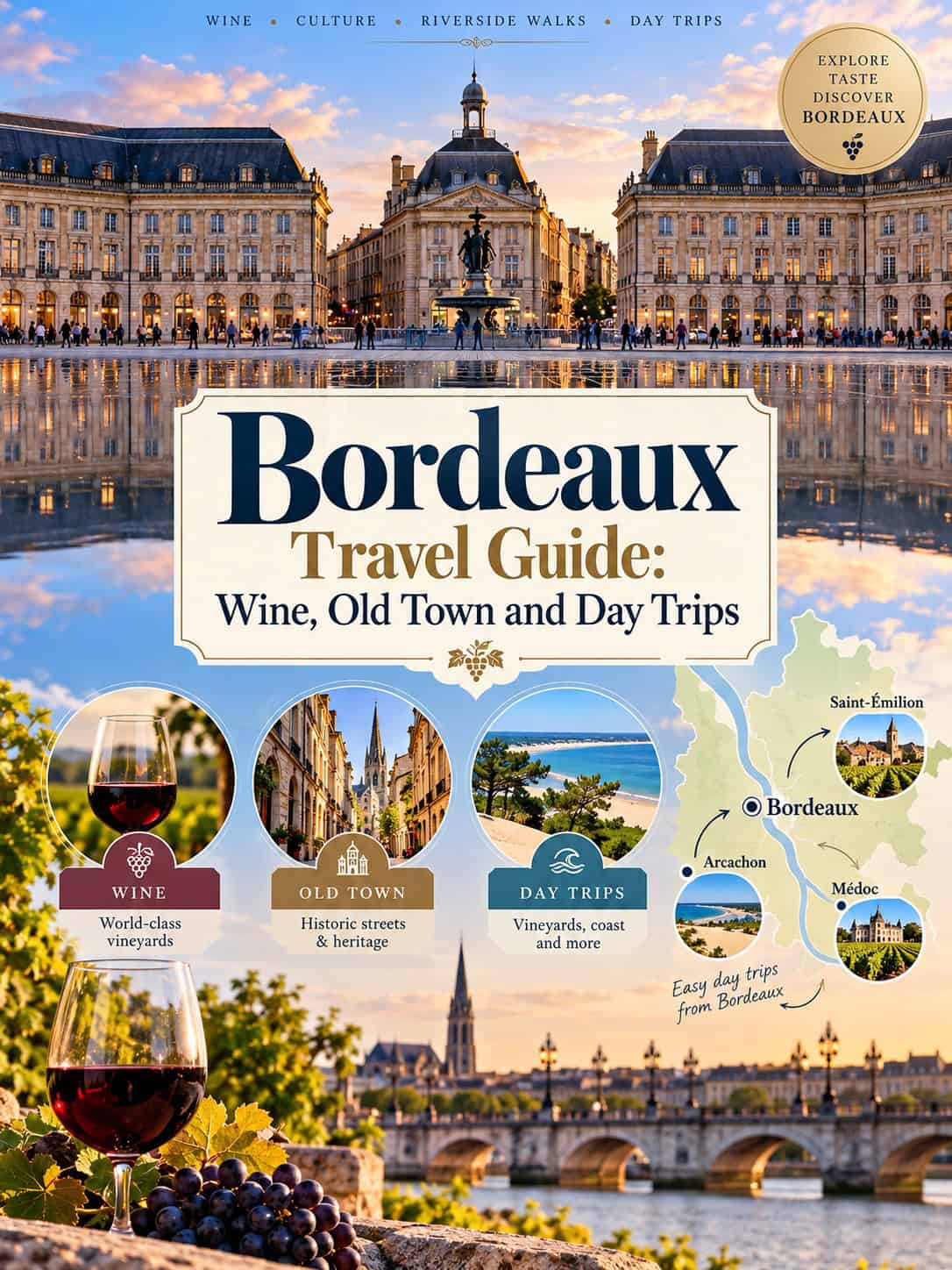
The best things to do in Bordeaux are on foot: the Miroir d’Eau and the old quays, the cathedral and its tower, the Capucins market and a wine museum on the river. This Bordeaux travel guide is built around a simple idea. The city is compact, flat and walkable, so a two-day Bordeaux itinerary covers the Bordeaux old town, and the rest of your time goes to Bordeaux wine tours and Bordeaux day trips to the vineyards and the Atlantic coast. Bordeaux sits on a wide curve of the Garonne, and that curve is the reason the old center was listed by UNESCO as the “Port of the Moon”. For the wine side of the story in a national context, see our overview of the best wine regions in France.
Also available in: 中文 · 한국어 · 日本語
Top 10 Things to Do in Bordeaux
These ten sights are inside the city. Day trips and wine-country excursions are listed separately below, so you can build a day around the city or a day around a trip.
| # | Sight | Best for | Time needed |
|---|---|---|---|
| 1 | Place de la Bourse and the Miroir d’Eau | Reflections, free, best at dusk | About 1 hour |
| 2 | Cathédrale Saint-André and the Pey-Berland Tower | Gothic cathedral and a city view from the tower | 1.5 to 2 hours |
| 3 | Grosse Cloche | Medieval belfry and old gate | 30 minutes |
| 4 | Basilica of Saint-Michel and its tower | Climb for a skyline view, flea market on set mornings | 1 hour |
| 5 | Marché des Capucins | Covered market, food and lunch at the counters | 1 to 1.5 hours |
| 6 | Rue Sainte-Catherine | Main pedestrian shopping street, a connector | 30 to 45 minutes |
| 7 | La Cité du Vin | Wine museum with a tasting glass at the top | 2 to 3 hours |
| 8 | Bassins des Lumières | Digital art in a former submarine base, good for rain | About 1 to 1.5 hours |
| 9 | Quays and Chartrons district | River walk, cafés, antique shops | 1 to 2 hours |
| 10 | Gare Saint-Jean area and tram rides | Transit hub and easy links to the rest | As needed |
A half-day plan: the walking route below plus the Capucins market. A full day: add La Cité du Vin or the Bassins des Lumières. Two days cover everything in the table.
Bordeaux Old Town on Foot: A Walking Route
This route follows the Bordeaux old town in a loop of roughly three to four hours with stops, and no map is needed because each leg is a short walk of about ten to fifteen minutes.
- Place de la Bourse and the Miroir d’Eau. Start at the river. Place de la Bourse is an 18th-century square with a classical facade, and in front of it lies the Miroir d’Eau, a shallow basin where a thin film of water reflects the facade, then gives way to a mist and the cycle starts again. It is free, and it is best at dusk when the stone is lit and the crowds have thinned.
- Walk inland to the cathedral. Follow the streets away from the river, passing Rue Sainte-Catherine, to Cathédrale Saint-André. Its freestanding bell tower, the Tour Pey-Berland, can be climbed by a narrow staircase of roughly 230 steps for a panoramic view of the city.
- Grosse Cloche. From the cathedral area, head back toward the river quarter to the Grosse Cloche, a Gothic belfry guarded by two pointed-roof towers. It stands on the vestiges of the medieval ramparts and once served as a city gateway.
- Saint-Michel. Continue south to the Basilica of Saint-Michel. Its bell tower, La Flèche, stands apart from the church and can be climbed. A market is held at the foot of the basilica on some mornings, with food and clothing on Saturday, second-hand goods on Sunday and clothing on Monday.
- Marché des Capucins. Finish at the covered market, the city’s biggest, a short walk further south. Go in the morning and eat at the counters; check the current hours before you plan lunch around it. For other regional specialties across the country, our guide to regional French dishes gives context.
Rue Sainte-Catherine is a pedestrian street about 1.2 km long between Place de la Comédie, where the Grand Théâtre stands, and Place de la Victoire. It is often billed as the longest pedestrian street in Europe and is the main shopping street, so treat it as a connector rather than a destination.
La Cité du Vin and the Bassins des Lumières
La Cité du Vin, on the river north of the center, is the city’s wine museum. The ticket includes a glass of wine or grape juice at the Belvédère on the eighth floor, with a panoramic view over Bordeaux and the Garonne. Reach it by tram and allow two to three hours. Opening hours and prices change by season, with longer hours in summer and shorter in winter, so confirm them on the official site before you go. If you want to understand the difference between Left Bank and Right Bank before you taste anything, this is the place to do it.
The Bassins des Lumières occupies a World War II submarine base and is billed as one of the world’s largest digital art centers. Paintings are projected onto the concrete walls and reflected in the water of the basins. A visit usually takes about an hour to an hour and a quarter. Exhibitions change each season, so check the official site before you commit. It works well on a wet afternoon and is unlike anything else in the city.
Bordeaux Wine Tours: Saint-Émilion vs Médoc
Bordeaux wine tours are the main reason many visitors come, and the two classic day trips are very different. Use this table to choose, then read the details below. No prices are listed because they depend on the operator and the season.
| Saint-Émilion | Médoc | |
|---|---|---|
| Bank | Right Bank | Left Bank |
| Without a car | Easy: TER train from Bordeaux Saint-Jean in about 31 to 35 minutes, then walk | Possible by TER to villages such as Margaux or Pauillac, but estates are spread out, so you need a taxi, driver or tour |
| With a guided excursion | Half-day or full-day tours from Bordeaux | Half-day or full-day tours, often the better choice |
| Time needed | Half a day to a full day | A full day |
| Style of tasting | Cellars inside a medieval hilltop village, with a walkable center | Famous estates in a long, flat landscape |
| Best for | First visit, no car, walking | Estates and Cabernet Sauvignon reds |
Saint-Émilion
The Jurisdiction of Saint-Émilion is UNESCO-listed as a cultural landscape. TER trains from Bordeaux Saint-Jean make the trip in about 31 to 35 minutes, so check return times before you set off and do not miss the last train. The monolithic church can be visited only on a guided tour sold by the tourist office, and tours are run in several languages. Buy your tour ticket as soon as you arrive. Walking, a tasting and lunch will fill the rest of a day.
Médoc
The Left Bank is a long, flat landscape of famous estates rather than a single village. A TER line from Saint-Jean calls at Margaux and Pauillac, with direct trains to Pauillac taking roughly an hour. The stations are in the villages, not at the estates, so decide before you go how you will reach the châteaux you want, and confirm each estate’s visiting arrangements in advance. If you are unsure between the two, choose Saint-Émilion if you prefer a walkable village and Médoc if the estates themselves are what you came for. A broader comparison with Burgundy and Champagne is in the wine regions guide.
Bordeaux Day Trips
These Bordeaux day trips leave the city and can each fill a day, so pick one for a short stay.
Arcachon, the Dune du Pilat and Cap Ferret
Arcachon is roughly 50 minutes from Bordeaux by direct train. From the station, a bus runs to the Dune du Pilat, so allow about an hour to an hour and a quarter for the whole journey, and check the current bus timetable before you plan the return. Boats also link Arcachon with Cap Ferret on the other side of the bay, and schedules vary by season. This is the best summer escape from the city.
Further afield: the Dordogne
Travelers with a car and several days can continue east into the Périgord. Our Dordogne travel guide covers the villages, castles and prehistoric caves, and Bordeaux works as a natural starting or finishing point for that loop.
Bordeaux Itinerary: Two to Four Days
- Day 1, the old town: the walking route above, a market lunch, then the quays and Chartrons in the evening.
- Day 2, museums: La Cité du Vin in the morning and the Bassins des Lumières in the afternoon, or swap them if it rains.
- Day 3, wine country: Saint-Émilion on your own by train, or a guided Médoc tour.
- Day 4, the coast: Arcachon and the Dune du Pilat.
If you are stringing several cities together, our guide to France by train explains how the TGV booking system and rail passes work, and the two-week Grand Loop itinerary shows where Bordeaux can slot into a longer route.
Bordeaux Travel Guide: Getting to Bordeaux and Getting Around
This Bordeaux travel guide starts with the practical part: Bordeaux is one of the easiest big cities in France to reach by rail. Direct TGV trains from Paris take about two hours, which makes a long weekend entirely realistic. Trains arrive at Gare Saint-Jean, south of the center, from where the tram links you to the old town. The tram is the best way to move around, and a single ticket costs under two euros. Check the local transport network site for the current 24-hour and 7-day passes before you buy. If you fly in, tram line A serves Bordeaux-Mérignac Airport, with a ride of about 35 minutes to Place Pey-Berland.
Where to Stay in Bordeaux
For a first visit, stay in the center near the quays, the Chartrons district or the area around Gare Saint-Jean for transport links. Our guide to the best hotels in Bordeaux by neighborhood compares areas and tiers, so you can choose where to stay in Bordeaux based on your plans.
When to Go and How Long to Stay
Spring and early autumn are comfortable for walking the city and visiting the vineyards, while summer is the busiest period on the coast. Book tours and tastings ahead whenever you travel. Any Bordeaux travel guide will tell you the same: two full days cover the center, La Cité du Vin and the Bassins des Lumières. Add a third day for one wine-country trip, and a fourth for the coast.
Frequently Asked Questions
What are the best things to do in Bordeaux for first-timers?
Walk the old town from Place de la Bourse to the cathedral and the Capucins market, visit La Cité du Vin, and add Saint-Émilion for wine.
How many days do you need in Bordeaux?
Two days cover the old town, the riverfront and La Cité du Vin. Three or four days allow time for Saint-Émilion, the Médoc or Arcachon.
Is Bordeaux walkable?
Yes. The historic center is flat and compact, and the tram handles longer hops such as La Cité du Vin or the airport.
Can you visit Saint-Émilion without a car?
Yes. TER trains from Bordeaux Saint-Jean take roughly 31 to 35 minutes, and the village is explored on foot. The monolithic church is visited only on a guided tour sold by the tourist office.
Saint-Émilion or Médoc for a wine tour?
Saint-Émilion is easier without a car and walkable. Médoc suits travelers who want the famous estates and are happy to book a tour or driver.
Is the Miroir d’Eau free?
Yes, entry to the Miroir d’Eau costs nothing.
How long is the train from Paris?
Direct TGV services take a little over two hours, making a weekend break practical.
How do I get to the Dune du Pilat?
Take the train to Arcachon, about 50 minutes from Bordeaux, then a local bus to the dune. Check the bus timetable for your date.
Bottom Line
Give Bordeaux two unhurried days for the river, the old streets, the market and the wine museum, then pick one trip that matches your taste: Saint-Émilion for a village, the Médoc for estates, Arcachon for sea air. Reserve tours and tastings ahead, check seasonal hours, and the city rewards you without the crowds of Paris.
Pingback: Best Hotels in Bordeaux: Where to Stay by Area.
Pingback: Dordogne Travel Guide: Lascaux, Castles and Villages.
Pingback: French Wine Regions: Bordeaux, Burgundy, Champagne & More
Pingback: French Food Guide: 15 Traditional Dishes by Region