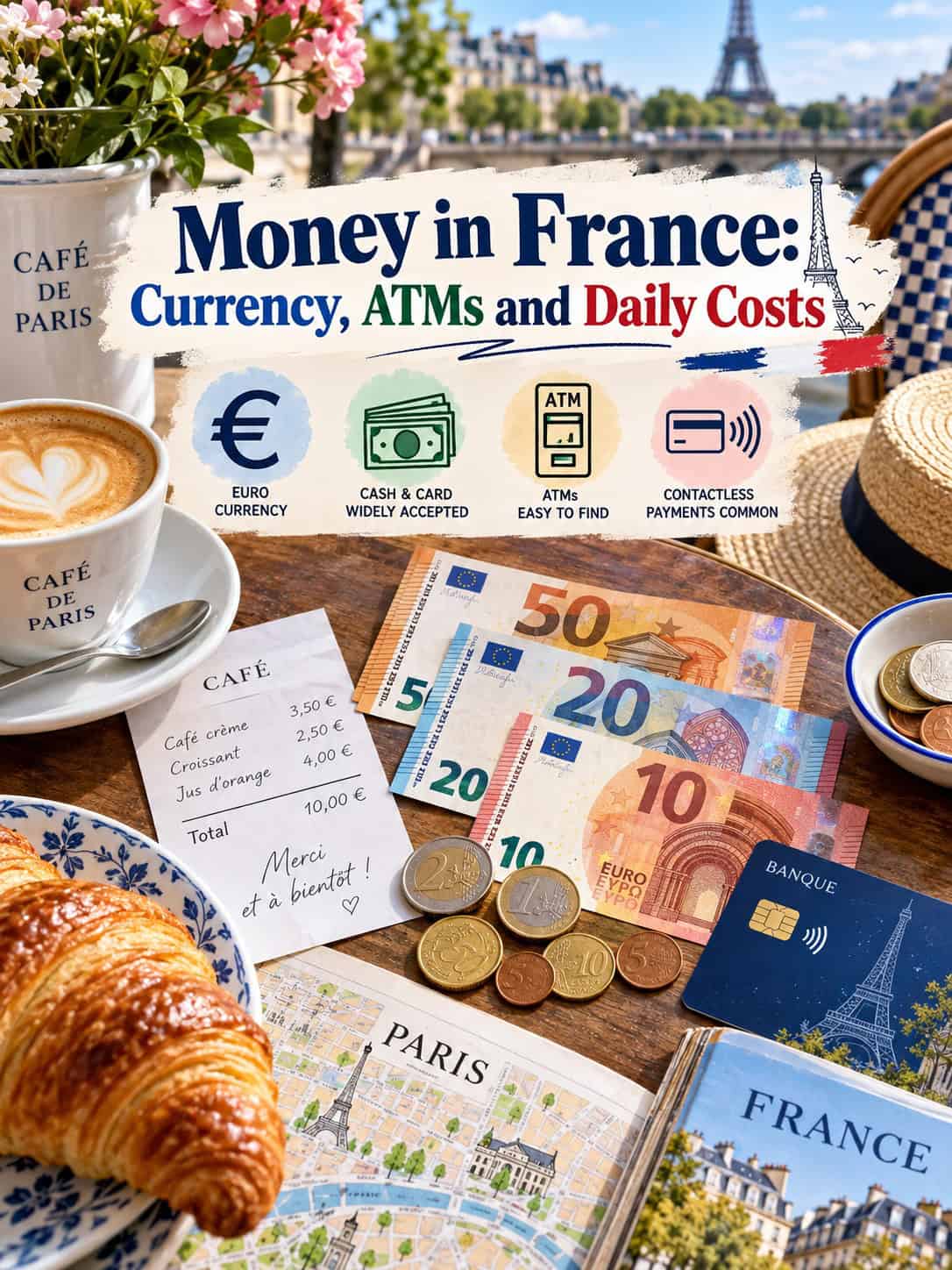
What currency is used in France? France uses the euro (EUR, €). Cards work almost everywhere, cash still helps at markets and in small places, and the biggest money savers are choosing euros at the terminal and withdrawing cash from a bank ATM. This guide covers currency in France, a payment matrix, ATMs, tipping, a realistic daily budget and tax refunds.
Also available in: 中文 · 한국어 · 日本語
Currency in France at a Glance: Cash, Card and ATM
| Question | Short answer |
|---|---|
| Currency | Euro (EUR, €); 100 cents = 1 euro |
| Cards | Visa and Mastercard are widely accepted; contactless and phone payments are common |
| Cash | Useful for markets, small cafes, villages and small purchases |
| ATMs | Use a bank-branch machine; avoid standalone private machines |
| Conversion prompt | Always choose euros, never your home currency |
| Exchange | Do not exchange money at home; withdraw a modest amount after landing |
Currency in France: Euros, Cash and Cards
France uses the euro, with coins from 1 cent to 2 euros and notes from 5 to 500. You do not need much cash on day one. Do not exchange money before you leave home, since rates at airport exchange desks are usually poor. A better plan is to arrive with a debit card and a credit card, withdraw a modest amount from a bank ATM after landing and use the card for most spending. Exchange bureaus in busy tourist areas often advertise attractive headline rates but add commissions or a wide spread, so compare the final amount you would receive.
Currency in France: Payment Matrix by Situation
| Where | Cards | Cash |
|---|---|---|
| City shops and restaurants | Widely accepted, contactless common | Rarely needed |
| Open-air markets | Some stalls accept cards, many prefer cash | Bring small notes and coins |
| Small villages and bakeries | Often accepted, but some set a minimum or are cash-only | Carry some cash |
| Public transport | Tickets and Navigo Easy can be loaded at machines and counters; some machines require a chip and PIN | Not needed for most rides |
Visa and Mastercard are accepted almost everywhere in cities and tourist areas. The contactless limit per payment is often 50 euros, and above that or after several taps the terminal asks for your PIN, so know it before you travel. Keep a second card and some cash as a backup. Check the foreign transaction fee on each card and your bank’s fee for foreign ATM withdrawals, since a card with no foreign fee is the single biggest saving for most visitors. Some banks send authorization codes by text, so see our France SIM and eSIM guide before you land.
ATM Fees in France: Where to Withdraw and What to Decline
A cash machine in France is a distributeur automatique de billets, often shortened to DAB. The best machines are inside or attached to a bank branch, such as those of BNP Paribas and Crédit Agricole, which are commonly recommended because they generally do not charge users a commission, though your own bank still may. Avoid standalone, brightly branded machines run by private operators in tourist streets and stations, because they commonly charge a fee and offer a poor conversion rate. A bank machine is rarely more than a few minutes away.
Currency in France: Always Choose Euros at the Terminal
Both ATMs and card terminals may offer to charge you in your home currency. This is called dynamic currency conversion, and the operator sets the rate, usually with a markup. Decline it and choose euros, so your own bank or card network converts at a better rate. The same applies in restaurants and hotels when the terminal asks, “Pay in USD or EUR?” Select EUR every time.
Currency in France: Withdrawal Limits and How Much to Take
Per-transaction limits are mostly set by your home bank. Since each withdrawal can carry a fixed fee at your own bank, withdraw fewer, larger amounts if you can carry the cash safely. Split cash between a money belt or inside pocket and your day bag, and see our guide to whether France is safe for tourists for pickpocket hotspots.
Tipping and Service Charges
Restaurant prices in France include service by law, which is why menus and bills often say service compris. A tip is optional, and there is no 15 to 20 percent rule. For each situation, including taxis, hotels and guides, read our dedicated tipping guide, which covers the full picture.
France Travel Budget: What a Day Really Costs
France is not uniformly expensive. Paris and the Riviera sit at the high end, while smaller cities and rural regions cost noticeably less. The biggest swing factor is almost always the hotel. Prices below were checked in October 2026 where an official source was available. Hotel and food lines are planning estimates and change by season, so treat them as a guide.
Currency in France Budget: Transport
Transport is a small line in your currency in France spending. The paper Ticket t+ is no longer sold, and Paris now runs on the reloadable Navigo Easy card, which costs 2 euros, or on a smartphone. A single Metro, train or RER ticket costs 2.55 euros and a bus or tram ticket 2.05 euros, with fares revised periodically. See our Paris transport guide for how the tickets work, including airport trips.
Sights and Activities
Admission is the item most travelers underestimate. Adult Eiffel Tower prices run from about 14.80 euros for the stairs to the second floor to about 36.70 euros for the summit by lift. The Louvre charges 22 euros for visitors from the European Economic Area and 32 euros for visitors from outside it. Many national museums offer free entry or reductions to some visitors, so read the eligibility rules, and see the holidays and festival calendar for closing days.
Accommodation and Food
For accommodation and food, hostel dorm beds in Paris run roughly 28 to 45 euros and mid-range three-star hotels roughly 130 to 220 euros per night, with higher prices around fashion weeks, big events and school holidays. For where to stay, see our Paris hotel guide. A baguette costs around a euro, a bakery breakfast is typically under 5 euros, and the lunchtime formule, a fixed-price menu around midday, commonly costs in the mid-teens to low twenties for two or three courses.
A Sample Daily Budget for Paris
These sample days are for one traveler in Paris and include a hotel or hostel bed. Sharing a room roughly halves the hotel line. The totals mix official prices (transport and sights) with estimated food and hotel costs.
| Style | What is included | Approx. total per day |
|---|---|---|
| Lean | Hostel bed (28 to 45 euros), bakery breakfast, formule lunch, picnic dinner, 2 Metro rides (5.10 euros), one sight (15 to 22 euros) | About 75 to 110 euros |
| Comfortable | Three-star room (130 to 220 euros), breakfast, bistro lunch, modest dinner, 4 Metro rides (10.20 euros), one sight (22 to 32 euros) | About 220 to 330 euros |
| Splurge | Boutique or luxury hotel, long dinner with wine, a guided visit and taxis | No practical ceiling |
Outside Paris, accommodation and restaurant lines are lower, but rail tickets, tolls and fuel add up if you travel between regions.
Currency in France: Tax Refunds for Non-EU Visitors
If your habitual residence is outside the European Union, you may reclaim VAT (TVA) on goods you buy in France and take home. You must be at least 16, be visiting for less than six months, and spend more than 100 euros including taxes in the same store on the same day. You must leave the EU with the goods and complete the customs validation before the end of the third month after the month of purchase. Restaurant meals, hotels and services are not eligible.
Ask the shop for a tax-free sales slip with the PABLO barcode at the till, keep it with your passport and validate it at a PABLO kiosk or customs desk before you check your bags, since officials may ask to see the goods. Customs does not refund the money itself: the merchant or its refund agent does, often minus a fee. Allow extra time at the airport. Visa rules are a separate subject, covered in our France visa guide.
Common Currency in France Mistakes to Avoid
- Accepting a conversion into your home currency at the terminal.
- Using a private, standalone ATM because it is closest.
- Arriving with only one card and no cash backup.
- Withdrawing cash in a hurry at a busy street machine at night.
- Handing your card to someone who walks off with it; ask for the terminal to be brought to your table.
- Forgetting your card PIN, which payments above the contactless limit require.
- Leaving a large tip out of habit when service is already included.
Frequently Asked Questions
What currency is used in France?
France uses the euro (EUR, symbol €), divided into 100 cents. Prices in shops already include VAT.
Can I use my credit card everywhere in France?
Visa and Mastercard are accepted in most shops, restaurants and hotels, but not everywhere. Carry some cash for markets, small cafes, villages and machines that need a PIN.
Where is the best place to withdraw cash in France?
A machine belonging to a major bank, ideally at a branch during opening hours. Avoid private standalone machines and always choose euros when asked about conversion.
Should I pay in euros or my home currency?
Always choose euros. Paying in your home currency is called dynamic currency conversion and usually gives a worse rate than letting your own bank convert.
Do I have to tip in France?
No. Service is included in restaurant prices, so a few coins for good service is a courtesy, not an obligation.
How much money do I need per day in France?
It depends mostly on your hotel. A lean day in Paris with a hostel bed can come in around €75 to €110, while a comfortable solo day with a three-star hotel is roughly €220 to €330. Outside Paris it is usually lower.
Can tourists get a VAT refund in France?
Yes, if you live outside the EU, are at least 16 and spend more than €100 in one store on one day. You validate the slip at departure, and the merchant or its refund agent pays the refund.
Bottom Line on Currency in France
For currency in France, bring two cards, withdraw modest amounts from bank ATMs, always pay in euros and keep a little cash for small purchases. Budget mostly around your hotel, eat the lunchtime formule and do not feel pressured to tip beyond a coin or two.
Pingback: Where to Stay Near Mont Saint-Michel: Island vs Mainland.
Pingback: Best Hotels in Paris: Right Bank vs Left Bank vs Marais.
Pingback: Best Hotels in Provence: 7 Countryside Mas and Bastides
Pingback: Tipping in France: How Much, Where and When