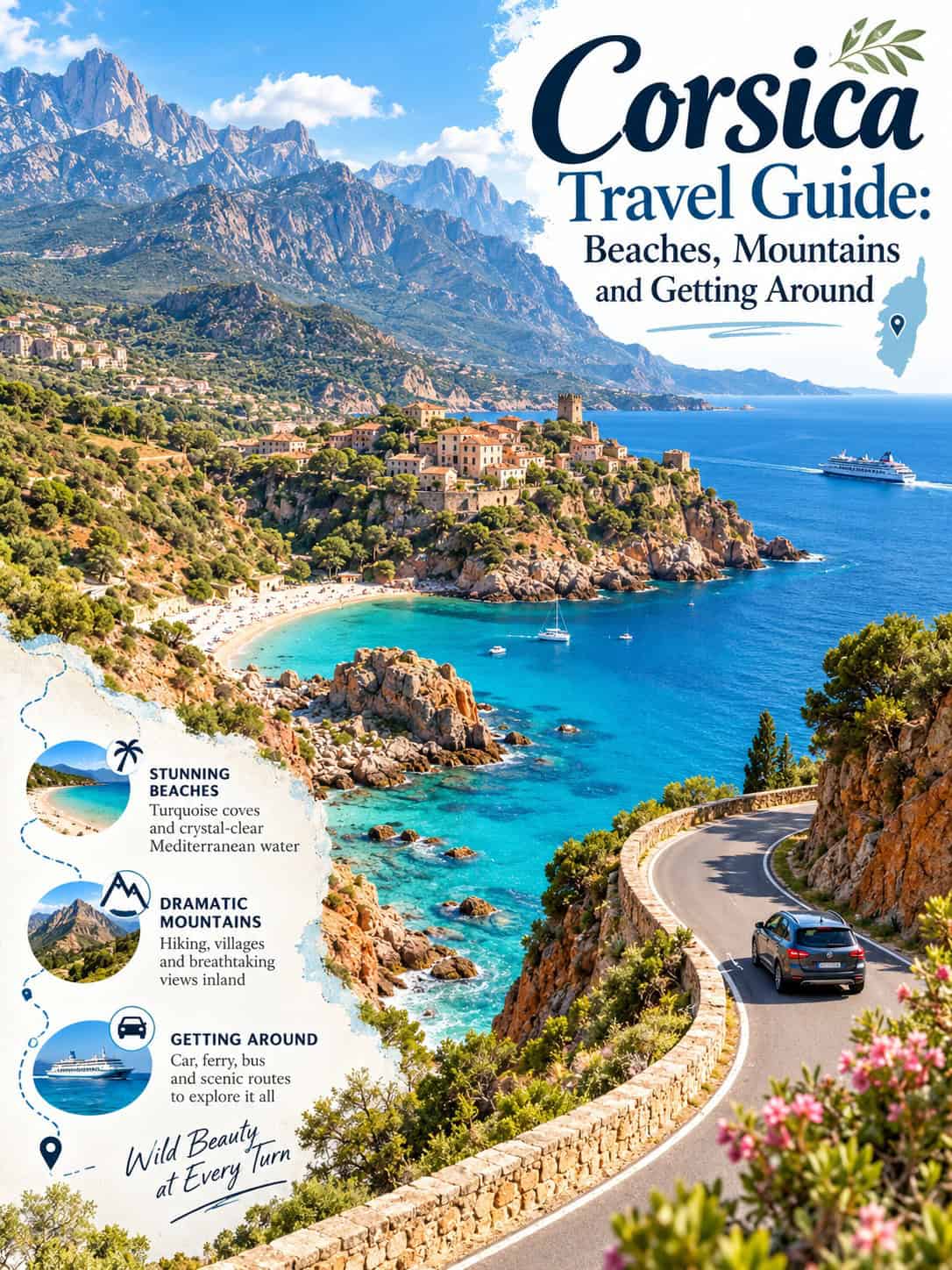
Looking for things to do in Corsica? Plan around the island’s mountain roads as well as its beaches: Corsica has no motorways, and short distances on a map can mean much longer drives in practice. Get that expectation right and the island rewards you with some of the clearest water in the Mediterranean, granite peaks you can walk up from the sea, and walled towns on cliffs. This Corsica travel guide covers beaches, mountains, ferries, trains and a practical Corsica itinerary, whether you are planning a Corsica road trip or exploring Corsica without a car.
Things to Do in Corsica: Plan Around Driving Distances
On a map Corsica looks small, but mountain roads are often narrow and winding. Allow generous time for transfers rather than estimating journey length from distance alone. Build every transfer day with generous margins and do not stack a long drive, a hike and a ferry in the same afternoon.
It helps to think in four bases rather than one island:
- North and Cap Corse (Bastia, Saint-Florent): the Agriates beaches, wine country and the finger-shaped peninsula of Cap Corse.
- Balagne (Calvi, L’Ile-Rousse): sandy town beaches, a rail line and the gateway to the northwest.
- West and southwest (Porto, Piana, Ajaccio): red-rock coastline, the Gulf of Porto and the island’s biggest airport.
- Far south (Porto-Vecchio, Bonifacio): the famous sand beaches and the clifftop citadel.
The center is the high country around Corte, with the GR20 running along the spine. Trying to see all of it in one week means constant driving; most travelers do better choosing two bases. If Corsica is part of a longer trip, our France 2-week itinerary shows how mainland stops fit together, and Corsica works best as its own add-on of five to ten days rather than a side trip squeezed in.
Things to Do in Corsica: Getting There by Ferry or Flight
By ferry
Ferries run from Marseille, Toulon and Nice to Corsican ports, operated by Corsica Linea, La Méridionale and Corsica Ferries among others. Crossing times vary by route and ship: ferry-booking listings show Marseille to Ajaccio at roughly 12 hours 45 minutes to 13 hours 45 minutes as an overnight sailing (a typical departure leaves in the evening and arrives around 7 a.m.), Toulon to Ajaccio at about 9 hours, and Nice to Ajaccio at about 7.5 to 8 hours on Corsica Ferries. Some routes sail only a few times a week, so check the operators’ own timetables. The big advantage is bringing your own car, which removes rental costs and lets you load up with hiking gear. The disadvantage is that overnight ferries need a cabin booked early in July and August.
By air
Corsica has four airports: Ajaccio (AJA, the biggest, for the southwest), Bastia-Poretta (BIA, for the north and Cap Corse), Calvi-Sainte-Catherine (CLY, for the northwest) and Figari-Sud Corse (FSC, for Bonifacio and Porto-Vecchio). Air Corsica and Air France connect them with mainland France, including Paris-Orly. Choose the airport nearest your first base, and consider an open-jaw ticket, arriving in one airport and leaving from another, so you never backtrack across the mountains. For comparison with mainland rail, see our guide to France by train, which does not extend to the island.
Things to Do in Corsica: Transport and Island Routes
Renting a car
For most itineraries a car is the practical choice. Book a rental car early for peak summer travel, especially if you need an automatic. Pick a compact car: village streets are narrow, you will meet buses on mountain bends, and parking is easier. Manual cars are generally much cheaper than automatics, so if you need an automatic, reserve early. Pick up at Ajaccio, Bastia or Porto-Vecchio for the widest choice. Budget for fuel and paid beach parking, and see our money in France guide for ATM and card tips, since small beach cafes and parking attendants can prefer cash.
The Corsican railway
The island has a small narrow-gauge network run as Chemins de Fer de la Corse: about 232 km of track and two lines, the central line between Bastia and Ajaccio via Corte and Venaco (around 158 km) and the Balagne branch from Ponte Leccia to Calvi via L’Ile-Rousse (around 74 km). Bastia to Ajaccio takes roughly 3 hours 45 minutes, and the Calvi branch connects with the main line at Ponte Leccia. The railway is a scenic option for Corsica without a car, stopping at Corte and Vizzavona on the main line. Timetables are limited and vary by season, so check the operator’s current schedule before planning connections.
Boats and buses
Some of the best Corsica attractions are easiest to explore by boat. Excursion boats serve beaches on the Agriates coast, sightseeing routes in the Gulf of Porto and the sea caves around Bonifacio. Buses link main towns but are infrequent, especially outside summer, so plan them around fixed departures.
Things to Do in Corsica: Best Beaches to Explore
Corsica’s beaches fall into two kinds: drive-up sand and effort beaches. Knowing which you are going to saves a lot of disappointment.
Palombaggia and Santa Giulia (south)
Palombaggia, south of Porto-Vecchio, is one of Corsica’s best-known sandy beaches, backed by pines and red rocks with views toward the Cerbicale Islands. Parking is limited around the beach, especially in high season; check current access and parking arrangements before setting out. Santa Giulia is a nearly enclosed gulf with a protected dune line and a very shallow, calm lagoon-like stretch of water, which makes it the easier choice with small children. Rondinara, a horseshoe-shaped bay nearby, is quieter and has a more secluded feel. In July and August all three are crowded by late morning; go early or late, or visit in June or September.
Saleccia and Lotu (the Agriates)
Saleccia is the textbook effort beach: sugar-soft sand and turquoise water on the wild Agriates coast, reached on foot, by 4×4 track or by boat. The easiest approach is a shuttle boat from Saint-Florent, which listings put at 20 to 30 minutes, with hourly departures through the day in season. Lotu lies next door, around an hour’s walk along the coast from Saleccia. Combination tickets let you go out to one beach and return from the other, which is the neat way to see both. Bring water and shade; there is little natural cover, and boats can be canceled in rough weather.
Choosing between them
- Families with young children: Santa Giulia for the shallow water.
- Classic postcard sand: Palombaggia, early in the day.
- A day with a sense of adventure: Saleccia plus Lotu by boat from Saint-Florent.
- Quiet swim off the main circuit: Rondinara outside high season.
Things to Do in Corsica: Mountain Hikes and the GR20
The GR20
The GR20 is a demanding long-distance trail across Corsica, approximately 180 km in 16 stages. Its steep, technical mountain terrain makes it suitable for well-prepared hikers. Most hikers go north to south, from Calenzana to Conca, and the road-and-rail village of Vizzavona sits near the midpoint, which lets you split the route into a northern half (harder, more technical) and a southern half. The main hiking season is generally June to early October, depending on snow and weather. Refuge staffing dates may differ from the safest conditions for hiking.
Overnight stays in park-managed GR20 refuges and designated bivouac areas require advance reservations. Camping outside authorised areas is prohibited. Check the park’s current reservation conditions and accommodation rates when planning your hike. If you do not have two weeks or the fitness, Vizzavona offers a one- or two-day taste of the southern section.
Day walks that do not require a commitment
- Restonica valley near Corte: leads to the mountain lakes of Melo and Capitello. Storm damage moved the trailhead to the Frasseta bridge, and the section before Lake Melo uses ladders and cables, so check current conditions with the Corte tourist office.
- Tavignano Gorge: a deep rocky valley with numerous pools, reached from Corte.
- Mare a Mare: a family of east-west trails based on old mule tracks and transhumance routes that cross the island between sea and sea.
Corte, a mountain town with a citadel, is the natural base for all three, and it is on the railway. Start early: summer afternoons bring heat and sometimes storms above the tree line.
Things to Do in Corsica: Coastal Sights and Villages
Gulf of Porto, Piana and Scandola
The Gulf of Porto on the west coast has been a UNESCO World Heritage site since 1983, covering the red-rock Calanques de Piana, the Scandola Nature Reserve and the Gulf of Girolata. Scandola cannot be reached by road or on foot, so a boat is the only way in; trips of roughly three hours from Porto are common, with departures dependent on sea conditions. The Calanques de Piana can also be seen by road. Book a morning departure, when the sea is usually calmer.
Bonifacio
Bonifacio is a historic fortified town perched above the sea on dramatic limestone cliffs. Its citadel, old streets and coastal viewpoints make it a highlight of southern Corsica. Walk the citadel and the old streets, then take a boat from the harbor or from Piantarella to see the sea caves, the base of the cliffs and the Lavezzi Islands nature reserve, a granite archipelago known for its blue water. Listed boat tours under the cliffs run about one and a half to two hours. Midday visits in summer are hot and crowded; early morning or late afternoon works better.
When to Go
May, June, September and October are widely recommended: sunny, less crowded and noticeably calmer. July and August are the busiest months and the most expensive, though sea temperatures peak then. For hiking, mid-June to early October covers the GR20, with the high passes safest in summer. For a month-by-month look at the whole country, see our guide to the best time to visit France, and remember that Corsica’s beach season and mountain season overlap only from about June to September.
Costs and Practicalities
Corsica is not a budget destination in summer. Ferry cabins, car rental and beachfront dining all rise sharply in July and August, and booking early is the cheapest single move you can make. Accommodation near the famous southern beaches fills first, so look at inland villages or off-peak weeks. Food is part of the draw, and our French food guide covers regional dishes.
Safety here is mostly about nature rather than crime. Mountain weather changes fast, trails can be rough, sea conditions can cancel boats. Take water, sun protection and offline maps, and tell someone your route before a hike. For general advice on personal safety and scams, our guide on whether France is safe for tourists covers the basics, and the Porto-Vecchio tourist office publishes a beach FAQ with local rules.
Things to Do in Corsica: A Seven-Day Road Trip
- Days 1 to 2, Bastia and Saint-Florent: arrive by ferry or air, taste the wine of the north, and take the boat to Saleccia and Lotu.
- Day 3, Corte: cross the interior and walk part of the Restonica valley.
- Days 4 to 5, Porto and Piana: boat trip to Scandola and the Calanques.
- Day 6, Ajaccio and the south: a long driving day toward Porto-Vecchio.
- Day 7, Palombaggia and Bonifacio: beach morning, citadel and cliffs in the evening, then fly home from Figari.
Bottom Line
For a balanced trip, choose two bases, reserve transport and mountain accommodation ahead, and leave room for both coastal and inland things to do in Corsica. Spend your effort on a boat day to Saleccia or Scandola, one mountain walk near Corte and one early beach morning in the south, and leave room for the island’s slow roads. Do that and Corsica feels like several trips in one rather than a race between ports.
Frequently Asked Questions
Do I need a car in Corsica?
For most itineraries, yes. Buses are infrequent and the narrow-gauge railway covers only two lines. If you stay in one town such as Calvi, Ajaccio or Bonifacio, you can manage without one, using boats and local transport.
How many days do I need for Corsica?
Five to seven days works for two bases, and ten days lets you combine the north, the west and the south without rushing. Trying to cover the whole island in three or four days means mostly driving.
Is the GR20 too hard for an average hiker?
It is demanding, with steep, rocky terrain and exposed sections, and it is regularly described as Europe’s toughest trek. Reservations are mandatory, so fitness and planning both matter. Shorter day hikes near Corte or Vizzavona are a gentler introduction.
Which Corsican beach is best for children?
Santa Giulia is often recommended because of its calm, shallow water over a wide band. Palombaggia is also popular but gets crowded.
What is the best month to visit Corsica?
June and September are the safest picks for warm weather and fewer visitors. July and August are hottest and busiest, and May and October suit hikers who accept cooler water.
Pingback: 法国最佳旅游时间:季节与地区全攻略.
Pingback: フランス旅行のベストシーズン:季節・地域別ガイド.