Planning the things to do in Lyon? This Lyon travel guide is built around three things the city does better than almost anywhere in France: eating, wandering a Renaissance old town, and slipping through hidden passages called traboules. Lyon rarely makes the first-timer shortlist, which is exactly why a night or two here feels like a discovery rather than a checklist. If you are building a longer route, Lyon slots naturally into the France 2-week itinerary as the pivot between Paris and the south or the Alps.
Top 10 Things to Do in Lyon
These are the Lyon France attractions most worth your time, with a rough duration, how to reach them and whether they cost anything. Times are approximate, and ticketed places can change hours, so confirm before you go.
| # | Attraction | Time needed | Getting there | Free or paid |
|---|---|---|---|---|
| 1 | Vieux Lyon and Saint-Jean cathedral | 2–3 hours | Walk or metro to Vieux Lyon | Free |
| 2 | Fourvière basilica and terrace view | 1–1.5 hours | Funicular from Vieux Lyon | Free entry, funicular paid |
| 3 | La Longue Traboule and other passages | 30–60 minutes | Walk | Free |
| 4 | Croix-Rousse, Mur des Canuts and Maison des Canuts | 2–3 hours | Metro line C | Free streets, museum paid |
| 5 | Place Bellecour and the Presqu’île | 1–2 hours | Metro or walk | Free |
| 6 | Les Halles de Lyon Paul Bocuse | 1–1.5 hours | Metro or walk | Free entry, food paid |
| 7 | A bouchon lunch or dinner | 1.5 hours | Walk | Paid |
| 8 | Musée des Confluences | 2–3 hours | Tram T1 | Paid |
| 9 | Institut Lumière | 1.5 hours | Metro or tram, then a short walk | Paid |
| 10 | Parc de la Tête d’Or | 2 hours | Metro line A, then a short walk | Free |
Is Lyon Worth Visiting?
Yes, especially if you like food and walking. Lyon sits where the Saône and the Rhône meet, and the city is organized around that geography. Two hills and a peninsula make up the historic core: Fourvière (the old Roman hill, topped by a basilica), the Presqu’île (the classical, shop-lined peninsula between the rivers) and the Croix-Rousse (the hill of the silk workers). Together with Vieux Lyon at the foot of Fourvière, these areas were inscribed as a UNESCO World Heritage site in 1998, so the city center itself is the attraction. You do not need a long list of ticketed sights to feel you have seen something.
Lyon rewards slow travel. Mornings go to markets and hill climbs, lunch is the main event, and the afternoon is for museums or a river walk. Rushing it into a few hours between trains means you will see the funicular and miss the point. Compared with Paris it is smaller, more walkable and less crowded; it is about two hours away by TGV, so it also works as a side trip from the capital (see our Paris guide).
Getting to Lyon and Getting Around
Paris to Lyon is about two hours by TGV, one of the easiest long-distance rail hops in the country. Lyon has more than one main station, so check which one your ticket names and which one your hotel is closer to. This guide to France by train and the TGV and rail pass system explains how fares and reservations work.
From Lyon-Saint-Exupéry airport, the Rhônexpress tram reaches the city in under 30 minutes, running about every 15 minutes during the day and less often early and late. The central districts are compact and walkable, and you will rarely need more than your feet plus the occasional hill-climbing ride. Check the local tourist office for public transport fares, passes and any city card, and do the math against the handful of paid museums you actually plan to enter before buying anything.
Vieux Lyon: The Renaissance Quarter
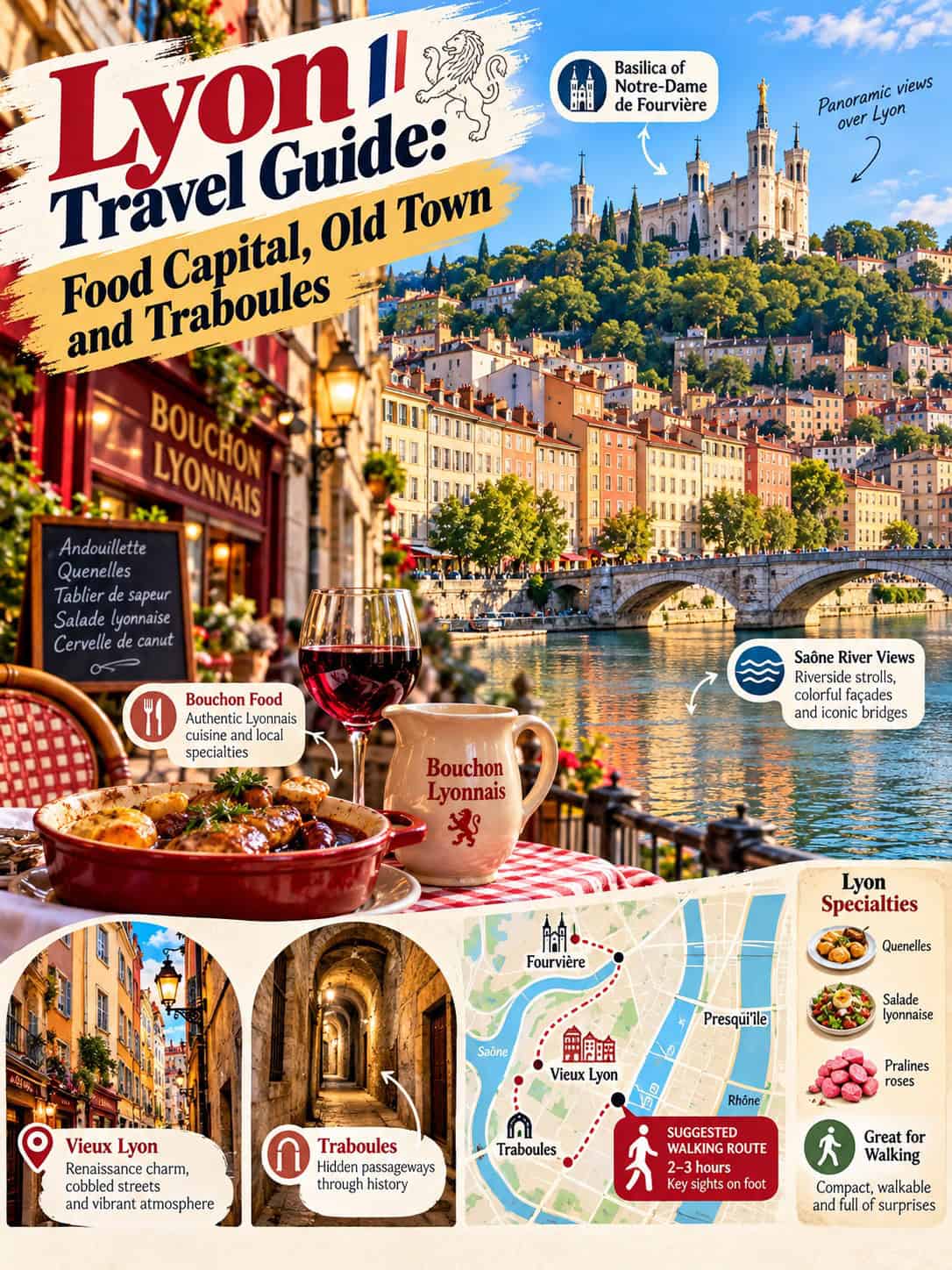
Vieux Lyon is a tangle of narrow streets between the Saône and the Fourvière hill, lined with Renaissance houses, and the lanes around Saint-Jean cathedral are its heart. Rue Saint-Jean is the busy spine and the most touristy, so walk it early or step into the side lanes. Behind the cathedral you can start the climb up toward Fourvière, either on foot (steep stairs and slopes) or by funicular.
Lyon Traboules: The Hidden Passageways
Traboules are passages that run through buildings and courtyards to connect one street directly to another. In Vieux Lyon they began in the Middle Ages, when only a few parallel streets existed between the hill and the river, and the passages made it faster to move between them. Lyon has hundreds of traboules across Vieux Lyon, the Croix-Rousse slopes and the Presqu’île, but only a fraction are open to the public, under an agreement between the city and the private owners. Most are in residential buildings, so treat them like someone’s front hall: keep your voice down, do not stop for long photo sessions and close the door behind you.
Traboules You Can Look For
- La Longue Traboule in Vieux Lyon runs from 54 Rue Saint-Jean to 27 Rue du Boeuf, and it is a good introduction because it feels like a real route rather than a staged sight.
- Cour des Voraces in the Croix-Rousse is the best-known traboule of the silk workers’ hill, with its monumental open staircases.
Do not expect every door to be unlocked. Access is at the residents’ discretion and can change, so a door that was open in a guidebook may be shut when you arrive. If a courtyard is closed or has a private sign, leave it; do not follow a resident in. A guided tour is the most reliable way to get inside several traboules at once, and the tourist office can point you to current options.
Croix-Rousse: The Silk Workers’ Hill
The Croix-Rousse is where Lyon’s canuts (silk weavers) lived and worked in tall nineteenth-century buildings designed around huge looms, and traboules here carried silk between workshops. It is a steep climb from the Presqu’île, but the neighborhood feels local and less polished than Vieux Lyon, which is a good thing.
Two stops fit well in one half-day. The Maison des Canuts, on rue d’Ivry, is the place to learn about the silk weavers and their craft. The Mur des Canuts, a 1,200 m² mural on the Boulevard des Canuts, shows how Lyon turned blank walls into street art; the city has more than 150 such murals, many created by the CitéCréation cooperative founded in 1978. Combine the visit with the Croix-Rousse market, which runs on most mornings and is busiest at the weekend; opening hours of shops and museums can vary by season, so confirm before you go.
Fourvière and Roman Lugdunum
Fourvière is Lyon’s oldest hill and was the site of Lugdunum, the Roman capital of the Gauls. The basilica, built between 1872 and 1896 and designed by Pierre Bossan, is the white landmark you can see from most of the city. Entry is free, but religious services affect access, particularly on Sunday mornings, so check the schedule before planning around it. The best approach is to ride the funicular up, visit the basilica terrace for the view, and walk back down into Vieux Lyon by lunchtime. Going down is far easier on the legs than going up.
Lyon Bouchons and the Capital of French Gastronomy
Lyon’s food reputation rests on a few things that are easy to verify: a covered market with serious producers, a restaurant type you will not find anywhere else, and a lineage of women chefs who shaped modern French cooking. For dishes across the country, see our French food guide to regional dishes; here is what is specific to Lyon.
How to Spot an Authentic Bouchon
A bouchon is a small, family-run restaurant serving traditional Lyonnaise cooking in an unpretentious setting. The word is used loosely by places aimed at tourists, so look for these signs:
- The Les Bouchons Lyonnais label, a sticker on the door or window featuring the marionette Gnafron, which signals respect for local recipes, ingredients and atmosphere.
- A short, handwritten or chalkboard menu of Lyonnaise dishes rather than a long multilingual list.
- Simple décor, shared or close tables and a lively, informal room.
- A fixed-price menu (formule) posted at the door, so check the menu and prices before you sit down.
Typical dishes to try include quenelles, salade lyonnaise, andouillette, saucisson brioché, cervelle de canut (a herbed fresh-cheese spread) and a praline tart for dessert. Book ahead for dinner, particularly on weekends.
Markets and the Mères
Les Halles de Lyon Paul Bocuse is the covered food market and a good lunch stop; check its current hours before you go. The Croix-Rousse market, described above, is a good, more local alternative. Lyon’s culinary history also owes a lot to the Mères lyonnaises, the women cooks who opened their own restaurants. The best known, Eugénie Brazier, became the first chef to hold six Michelin stars, three each at two restaurants, in 1933, a record not matched until Alain Ducasse in 1998. You do not need to book a starred table to appreciate this: the tradition lives on in the simple, generous cooking of the bouchons.
Museums Worth Your Time
The Musée des Confluences, at the tip of the peninsula where the rivers meet, is a striking building with natural history and anthropology collections and a good rainy-day plan. The Institut Lumière is the place to learn how Lyon helped give birth to cinema. Both are normally closed on Mondays, so plan your museum day for another day of the week, and check current hours and ticket prices on their official sites.
Green Space and Big Squares
Parc de la Tête d’Or is free to enter and is the easy answer to a sunny afternoon. Place Bellecour, which measures 312 by 200 meters and is billed as the largest pedestrian square in Europe, is a useful meeting point between the old town and the shops of the Presqu’île.
When to Go: Fête des Lumières and the Seasons
The Fête des Lumières, the Festival of Lights, is held around 8 December. It began on 8 December 1852, when residents put candles in their windows to celebrate the inauguration of the statue of the Virgin Mary on Fourvière hill. Today the facades and squares host light installations. The exact dates and programme are set by the organizers each year, so check with them before you book. It is the busiest week of the year in the city: reserve accommodation early and plan walking routes outside peak evening hours. See also France events in December.
Outside that week, Lyon works year-round, since its main draws (walking, markets, bouchons) do not depend on one season. If burgundy wines are your focus, the Burgundy guide to wine villages, Dijon and Beaune is the natural next stop, and if your route continues into the Alps, the Annecy guide covers another one.
Where to Stay in Lyon
The three most useful bases are the Presqu’île (central, near Bellecour and the shops), Vieux Lyon (atmospheric and walkable, but built on hills and stairs) and the area around the main train station (practical for trains, less charming). Your choice depends on whether you value atmosphere or a short walk to the station. For picks organized by district, see the best hotels in Lyon by neighborhood.
A Two-Day Lyon Itinerary on Foot
Each day stays inside one cluster, so you spend your time walking rather than commuting.
Day One: Vieux Lyon and Fourvière
- Morning: funicular up to Fourvière basilica and the terrace, then walk down into Vieux Lyon.
- Afternoon: Saint-Jean cathedral, La Longue Traboule and the lanes between Rue Saint-Jean and the Saône.
- Evening: dinner at a bouchon carrying the official label, booked ahead.
In words: start on the hill, drift downhill to the river, and finish within a few streets of the Saône.
Day Two: Presqu’île and Croix-Rousse
- Morning: Place Bellecour and the Presqu’île, then walk or ride north toward the Croix-Rousse.
- Late morning: the Croix-Rousse market, the Cour des Voraces, the Mur des Canuts and the Maison des Canuts.
- Afternoon: a long lunch, then the Musée des Confluences or the Institut Lumière (not on a Monday), or Parc de la Tête d’Or.
In words: walk the peninsula from south to north, climb the silk hill, and come down for your last meal.
Lyon Travel Guide FAQ
How many days do you need in Lyon?
Two days covers Vieux Lyon, Fourvière and the Croix-Rousse at a comfortable pace, and three lets you add a museum, a park and a long market lunch.
Is Lyon worth visiting compared with Paris?
It is a different trip rather than a lesser one: smaller, more walkable, better for food and less crowded. It is about two hours from Paris by TGV, so it also works as a side trip.
Can you visit the Lyon traboules on your own?
Yes, some are open to the public, but they are in residential buildings and access can change. Be quiet and respectful, leave closed courtyards alone, or join a guided tour for reliable access.
What is a bouchon in Lyon?
A small, informal restaurant serving traditional Lyonnaise cooking. Look for the official Les Bouchons Lyonnais label and a short menu of local dishes.
Where to stay in Lyon for the first time?
The Presqu’île is the most central base, Vieux Lyon is the most atmospheric, and the area around the main station is the most practical for trains.
When is the Festival of Lights in Lyon?
The Fête des Lumières is held around 8 December. The exact dates and programme are published by the organizers, so check with them and book early.
Bottom Line
Lyon is best treated as a slow, food-led city break: climb Fourvière, wander the traboules in Vieux Lyon and the Croix-Rousse, and plan at least one proper bouchon dinner and one market morning. Check museum hours, traboule access and Festival of Lights crowds before you commit your dates.
Pingback: Best Hotels in Lyon: Where to Stay by Neighborhood.
Pingback: Things to Do in France in December: Events & Festivals
Pingback: Lake Annecy France: Essential Sights and Travel Guide