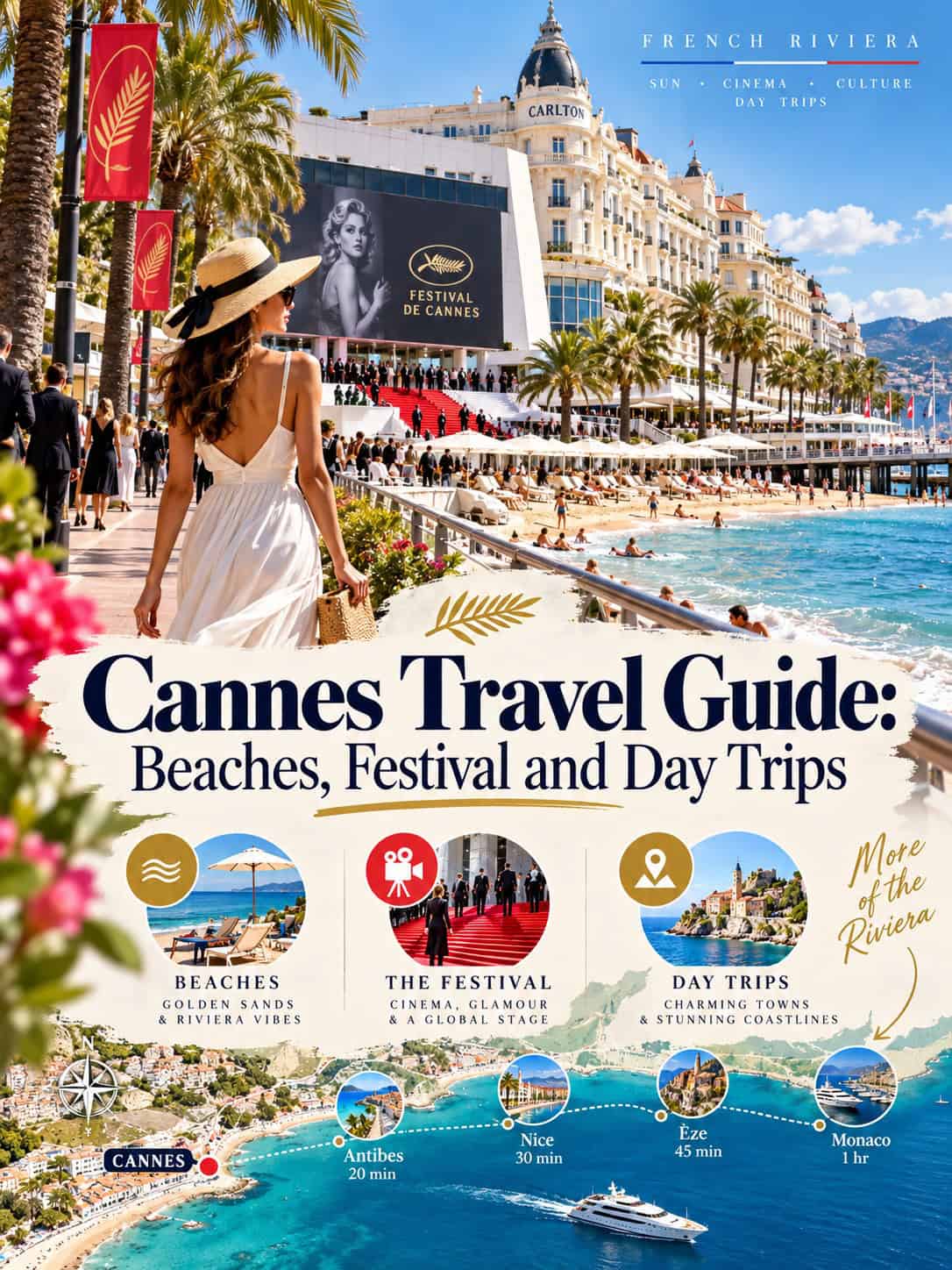
Looking for the best things to do in Cannes? Start with the public beaches, Le Suquet old town, the famous film festival sights and a boat trip to the Lérins Islands. This guide also covers practical day trips and where to stay in Cannes. Cannes is compact, walkable and busiest when a trade fair is in town, so a little planning changes the trip more than any single sight. If you are building a longer coast itinerary, our Nice and French Riviera guide shows how Cannes fits into the wider region.
Best Things to Do in Cannes at a Glance
Cannes is a small seafront city on the western side of the Riviera, built around three things: the Croisette promenade, the old port with the Palais des Festivals at its edge, and the hilltop old quarter of Le Suquet. Almost everything a visitor does sits within a flat 30-minute walk, with the train station in the middle of town. The city is also a business destination, so trade fairs, not just beach weather, decide how crowded and expensive a given week will be.
| Area | What it is | Best for |
|---|---|---|
| La Croisette | Seafront boulevard with grand hotels, luxury shops and beaches | Strolling, beach days, people-watching |
| Le Suquet | Hilltop old quarter, Roman-era origins, medieval castle | Views, museum, quieter evenings |
| Rue d’Antibes and the Carré d’Or | Main shopping street and the boutiques between it and the Croisette | Shopping, cafes |
| Old Port and Quai Laubeuf | Yachts, restaurants, ferry departures | Island trips |
Cannes Beaches: Free, Municipal and Private
Cannes France beaches are known for their fine sand, with free public areas, municipally managed sections and private beach clubs. Along the Croisette, many beachfront areas are operated by hotels and restaurants, but visitors can also choose public beaches without renting a lounger.
- Free public beaches. The municipal free beaches are raked daily in season and have showers and toilets. Plage du Midi, along Boulevard Jean Hibert, west of the old port, is calmer than the central stretch.
- Municipal beaches with rentals. Plage Macé, by the Palais des Festivals, has a free section and a municipal section where loungers and umbrellas cost noticeably less than the hotel clubs. Plage Zamenhoff, next to the Parc Croisette car park, works the same way. Rates there are lower than at the hotel clubs.
- Private beach clubs. Cannes beach clubs typically charge for sunbeds and umbrellas, with prices varying by venue, season and location. Some also offer restaurant service, so check the conditions before reserving.
- Seasonal operators on public sand. Some beach areas offer equipment rentals without the full private-club experience. Check locally whether sunbeds and umbrellas are available and what the rental includes.
A practical routine: bring a towel, claim free sand early at Plage du Midi, and keep a rented lounger for the hottest afternoon only. Prices are from guide listings and move between seasons.
The Cannes Film Festival: What the Public Can Actually Do
The Festival de Cannes primarily serves film professionals, and its main screenings require the appropriate accreditation and tickets. However, visitors can enjoy selected public programmes, including the free Cinéma de la Plage screenings. That surprises people who expect to walk in.
The 2026 edition ran from 12 to 23 May. The festival is held each spring; the dates for the next edition are posted on the official Festival de Cannes site.
What is free
- Cinéma de la Plage. Each evening at 9:30 pm, outdoor screenings run on Plage Macé on a giant screen with roughly 800 loungers. In 2026 it was free with no badge or registration, with 11 screenings between 13 and 23 May. Arrive early; seating is first come, first served.
- The red carpet from outside. During the festival you can watch from the barriers near the Palais but you cannot climb the steps. The wait for a view is long and patience is the entry fee.
- The steps outside festival season. The rest of the year the steps can be climbed and photographed for free, though access is sometimes closed for events.
Plan for the other side as well: festival fortnight is the most expensive and crowded time of the year, so book accommodation very early or consider staying outside the center.
Things to Do in Cannes: Explore Le Suquet Old Town
Le Suquet is Cannes’ historic hilltop quarter, where narrow cobbled lanes lead to the Musée des explorations du monde, formerly known as the Musée de la Castre. Housed in a historic fortified complex, the museum has a medieval tower with 109 steps and panoramic views over Cannes and the coast. Nearby is the church of Notre-Dame d’Espérance.
At the foot of the hill, Marché Forville is a popular Provençal food market. During renovation works, traders operate across designated market areas, including the Allées de la Liberté. Opening days and hours vary by season; a separate flea market traditionally takes place on Mondays. Go before noon. Rue d’Antibes is the main shopping street. The Suquet loop plus market makes a good morning when the beach is crowded.
Lérins Islands: The Best Half-Day Away From the Croisette
Two islands lie off the coast (see also the France.fr guide to the Lérins islands and the Cannes tourism office): Sainte-Marguerite and Saint-Honorat, about a kilometer apart. Boats leave from Quai Laubeuf by the old port, and the crossing takes roughly 15 minutes to Sainte-Marguerite and about 15 to 20 to Saint-Honorat. Services run at intervals of around 30 to 90 minutes depending on the season, and different companies serve each island, so match the return time to the right operator before you walk off.
Sainte-Marguerite
The larger island holds the 17th-century Fort Royal, where the Man in the Iron Mask was held from 1687 to 1698, and the Musée de la Mer inside the fort displays finds from local shipwrecks and the island’s history from the Ligurians and Romans onward. The rest of the island is pine forest with walking paths and small coves. Trans Côte d’Azur operates regular return ferries to Sainte-Marguerite. Check the current adult fare and sailing schedule before travelling, as prices and departure times can change.
Saint-Honorat
Saint-Honorat is the quieter island. The island has a monastery, and a small Cistercian community still lives and works there, producing wine from vineyards on the island. The abbey’s restaurant La Tonnelle serves lunch with island wine. Because this is a working monastery, dress and behave accordingly, and expect the boat timetable, not the sights, to set your day.
Planaria operates ferries between Cannes and Saint-Honorat. Check its current return fares and departure schedule before planning your visit. A sensible plan: take a morning boat to Sainte-Marguerite, picnic by the water, and move on to Saint-Honorat if time allows. Do not try both at midday in August without checking the last return sailings.
Day Trips by Train From Cannes
The coastal TER line runs from Cannes through Antibes, Nice, Monaco and on to Menton and Ventimiglia, with some trains running direct. Antibes, Nice and Grasse are all accessible by train from Cannes, making them practical day-trip options. Journey times vary by departure and service. Check the SNCF Connect site for the price of your train.
- Antibes. The nearest stop and an easy half day with ramparts, market and sea walks. It is also the quickest escape when Cannes is overloaded.
- Nice. A full-day city, and the subject of our French Riviera 5-day itinerary, which strings Nice, Cannes and the villages together in a sensible order. For a hilltop village stop on the same coast, see our Eze and Riviera hilltop villages guide.
- Grasse. Perfume capital, about 20 km north of Cannes. The three historic perfumeries, Fragonard, Molinard and Galimard, offer free guided workshop visits, and Galimard dates from 1747. The Musée International de la Parfumerie, with its plant gardens at Mouans-Sartoux, is the deeper cultural option. Trains and buses both serve Grasse; buses are less frequent, so check the time of the last return.
Getting There and Around
Most visitors arrive via Nice Côte d’Azur airport, roughly 28 km from central Cannes. Options include the train via Nice, an express airport bus and private transfer; the express bus 81 (formerly 210) takes about 50 minutes from the airport to central Cannes and costs more than the train. Our Nice Airport guide covers the transfer choices in detail. Inside Cannes you will not need transport: walk, and use the train for anything outside town.
When to Go and How Busy Cannes Gets
Cannes is a trade-fair city. Its calendar includes MIPIM (15 to 19 March 2027), the festival in May, Cannes Lions (21 to 25 June 2027), the Yachting Festival (8 to 13 September in 2026) and MIPCOM in mid-October (listed for October 2026 at the Palais). Each fills the hotels and pushes up prices. For a beach trip, the shoulder months around June and September can be pleasant for the beach, but if your dates overlap with an event, check rates before you commit.
Where to Stay in Cannes
Decide between three zones. The Croisette gives sea views and the highest rates. The center near Rue d’Antibes and the station is the best value for walking and train day trips. Le Suquet is quiet, with steep streets that are tiring with luggage. If you want to compare hotels across the whole coast, see our best hotels in Nice and the French Riviera. Book well ahead for any event week.
Bottom Line
Cannes rewards a slow two or three days: a free beach morning, the Suquet climb, one island boat and one train excursion to Antibes or Grasse. Check the event calendar before booking, and treat the festival as something to see from the edges rather than something to enter.
Frequently Asked Questions
Can tourists attend the Cannes Film Festival?
Screenings require professional accreditation. The public can watch the free Cinéma de la Plage on Plage Macé and view the red carpet from outside the barriers.
Are Cannes beaches free?
Some are. The city maintains free public beaches such as Plage du Midi, and part of Plage Macé is free. The beaches in front of the Croisette hotels are private clubs, with lounger rental starting around 25 euros.
How do I get to the Lérins Islands?
By ferry from Quai Laubeuf in Cannes. The crossing takes about 15 to 20 minutes; Trans Côte d’Azur serves Sainte-Marguerite and Planaria serves Saint-Honorat.
Is Cannes worth a day trip from Nice?
Yes. The train ride is short, enough time for a beach, Le Suquet and lunch at the market, though the islands need a full half day.
What are the best things to do in Cannes for first-time visitors?
Walk along La Croisette, explore Le Suquet, visit the Palais des Festivals from outside and spend time on a public beach. If your schedule allows, take a boat to one of the Lérins Islands.
Which Cannes France attractions are worth visiting?
Popular Cannes France attractions include the Palais des Festivals, the historic Le Suquet neighbourhood, the Musée des explorations du monde and the Lérins Islands.
Which Cannes beach clubs should visitors choose?
Beach clubs along La Croisette offer sunbed rentals and restaurant service. Compare the location, rental conditions and current prices before choosing a club.
Where to stay in Cannes for a first visit?
Stay near La Croisette for the seafront, around Rue d’Antibes and the railway station for shopping and transport, or in Le Suquet for a historic atmosphere.
How many days do you need for a Cannes itinerary?
A one-day Cannes itinerary can cover La Croisette, the Palais des Festivals, Le Suquet and the old port. Add another day for a Lérins Islands excursion or a slower beach visit.
Pingback: 尼斯最佳酒店与里维埃拉住宿推荐.
Pingback: French Riviera 5-Day Itinerary: Nice, Cannes, Villages.
Pingback: 프렌치 리비에라 여행 가이드: 니스, 해안, 당일 여행.
Pingback: Best Hotels in Nice France: Where to Stay & Full Guide