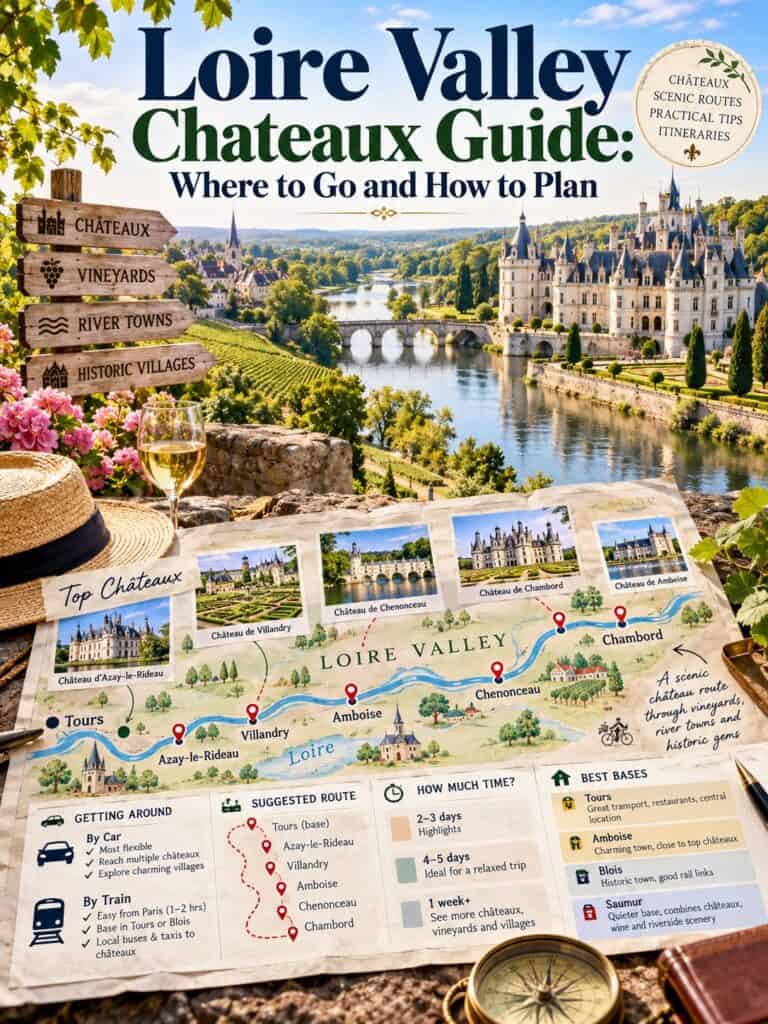
Loire Valley castles are plentiful, with more than three hundred châteaux, so the key is choosing a few. Pick three or four, group them by geography, and choose a base town before you book anything. This Loire Valley chateaux guide covers what sets each major château apart, a comparison table with winter opening, visit time, car needs and arrival station, 1, 2 and 3 day itineraries, and how to do the Loire Valley without a car. For rail and tour mechanics from the capital, see our guide to getting from Paris to the Loire Valley.
Also available in: 中文 · 한국어 · 日本語
Loire Valley Castles at a Glance: Compare the Main Châteaux
Use this table to compare the headline sites. Opening days, hours and seasonal closures change, so confirm them on each château’s official website before you plan a day around it.
| Château | Open in winter? | Typical visit time | Car needed? | Arrival station |
|---|---|---|---|---|
| Chambord | Generally yes, with shorter hours, and closed on a few holidays | Half a day (3 to 4 hours with the grounds) | Easiest by car. Without a car, use a taxi, bike or seasonal shuttle from Blois | No station at the château. The nearest rail access is Blois |
| Chenonceau | Generally yes, with hours that vary by season | 2 to 3 hours | No. A short walk from the station | Chenonceaux station, a small station on a TER line from Tours |
| Amboise (royal château) and Clos Lucé | Generally yes | 2 to 4 hours for both | No | Amboise station, then a walk or short taxi |
| Blois | Generally yes | 1.5 to 2 hours | No | Blois-Chambord station, in the town |
| Cheverny | Generally yes | 1.5 to 2 hours | Easiest by car, with limited public options | No station at the château. A seasonal shuttle from Blois may stop here |
| Villandry (gardens) | Check the official calendar, since some winter closures apply | 2 to 3 hours | Easiest by car, with limited public options | No station at the garden. A station in a nearby village is the closest rail access |
| Azay-le-Rideau | Generally yes | 1.5 to 2 hours | Not essential, but a car saves time | Azay-le-Rideau station on the line from Tours |
What the Loire Valley Actually Is
The stretch of the Loire protected by UNESCO since 2000 runs about 280 km between Sully-sur-Loire and Chalonnes, and it covers towns, villages, farmland and the river itself. In the late 15th and 16th centuries the kings of France spent much of their time here, and courtiers built residences nearby. That is why a medieval fortress, a hunting lodge, a bridge-palace and a formal garden can sit within an hour of each other. Treat the Loire Valley castles as a sequence of different building types, not one repeated experience.
The Big Names: What Each of the Loire Valley Castles Offers
Chambord: the scale
Chambord is the château that stops people in the car park. Construction began in 1519 under Francis I, and it stands inside a walled forest estate of more than 5,000 hectares. Its signature feature is the open double-helix staircase, long linked to Leonardo da Vinci, though that attribution is tradition rather than proof. Chambord was a hunting lodge, so much of the interior is sparse, and the roofline terraces and grounds are the real draw. Allow half a day. Opening hours and prices change, so check the official website.
Chenonceau: the bridge
Chenonceau spans the River Cher on arches and is often called the Ladies’ Château because women shaped it. Henry II gave it to Diane de Poitiers, who had the arched bridge built, and after his death Catherine de Medici took it over and added the two-story Grand Gallery, which is the image everyone remembers. Opening hours and tickets change by season.
Amboise and Clos Lucé: the Leonardo connection
Amboise is the easiest château town to reach by train, and the royal château is a short walk from the station. Francis I was raised here, and Leonardo da Vinci lived at the nearby manor of Clos Lucé, where he died in 1519. The Saint-Hubert chapel in the château gardens is traditionally held to be his resting place. You can see the manor and the chapel on the same afternoon.
Blois: the royal history lesson
Blois sits in the middle of a town, and four periods of French architecture meet around one courtyard. The François I wing has a celebrated spiral staircase decorated with the king’s salamander emblem. Blois is also where Henry III had the Duke of Guise murdered in 1588. If you prefer stories to furniture, it is the strongest narrative site in the valley.
Cheverny: still a family home
Cheverny is still owned and lived in by descendants of the Hurault family, and it keeps a pack of hunting hounds. Fans of Tintin will recognize it as the inspiration for Moulinsart Castle, which has a permanent exhibition in the outbuildings.
Gardens: Villandry, Azay-le-Rideau and Chaumont
Villandry is the garden château, known for its formal kitchen garden. Chaumont-sur-Loire hosts an international garden festival each year, usually from spring to autumn. Opening seasons for gardens vary, so check before planning around them.
Loire Valley Itinerary: 1, 2 and 3 Days
Do not assume all the Loire Valley castles are close together. Distances between sites vary, and the pace in the valley is slower than the map suggests. As a rough guide, Amboise and Chenonceau are a short drive apart, while Chambord and Chenonceau are about an hour apart by car. Check travel times for your own route.
1 day
- Take a direct train from Paris to Amboise, visit the royal château and Clos Lucé, or take an organized tour from Paris that covers several châteaux in one long day.
2 days
- Day 1: Amboise and Chenonceau. Amboise has its own station, and Chenonceau is reached by a short train or taxi.
- Day 2: Blois and Chambord. From Blois, use a taxi, bike or seasonal shuttle for Chambord, or drive.
3 days
- Day 1: Amboise and Clos Lucé, then Chenonceau.
- Day 2: Blois and Chambord, with Cheverny if you have a car.
- Day 3: Villandry and Azay-le-Rideau, plus a wine afternoon near Tours.
A useful rule is no more than two major châteaux a day. Pair a big château with a town or a garden to keep the pace human.
Where to Base Yourself for Loire Valley Castles: Tours, Amboise, Blois or a Château Hotel
- Tours: the best choice without a car, with the largest choice of restaurants and a rail hub at Saint-Pierre-des-Corps.
- Amboise: small, walkable, with the château and Clos Lucé in town.
- Blois: central for Chambord and Cheverny.
- A château hotel in the countryside: memorable, but practical mainly with a car. Our guide to Loire Valley château hotels compares options.
Getting to the Loire Valley Castles and Getting Around
From Paris Montparnasse, TGV trains take about an hour to Saint-Pierre-des-Corps, the Tours-area station, and direct trains run to Amboise and Blois in roughly 1 hour 30 minutes to 2 hours. Check the live timetable for the train you want, and see how the TGV and rail pass system works for tickets and reservations.
Driving gives the most freedom, especially for Cheverny, Villandry and Azay-le-Rideau. The classic cycling option is the Loire à Vélo route, a long-distance cycle route along the river, and a stretch between Blois, Chaumont and Amboise is a manageable day or two for a fit rider. Organized tours from Paris combine several châteaux in one long day, which is efficient but leaves little time at each.
Loire Valley without a car
The Loire Valley without a car is possible, but plan it around the trains and accept some limits.
- Train only: Amboise, Blois and Chenonceau are reachable by train. Chenonceaux station is a short walk from the château, though service is less frequent than on the main lines.
- Train plus shuttle or bus: Chambord and Cheverny have no station. A regional bus or seasonal shuttle runs from Blois, with limited schedules, so check the operator before you build a day around it.
- Train plus bike: bikes can be rented in the main towns, and cycling the Loire à Vélo between Blois, Chaumont and Amboise works for fit riders. Check rental and train-with-bike rules in advance.
- Train plus tour or taxi: a guided half-day tour or a pre-booked taxi from Tours, Amboise or Blois covers sites without a station. Prices vary, so compare options.
- Limits: you will likely fit fewer sites per day, and Villandry, Cheverny and the smaller châteaux are the hardest. Base in Tours or Amboise and be realistic.
Loire Valley Castles Tickets: Buy from the Official Sites
In summer, book timed tickets for the busiest Loire Valley castles, and buy them directly from each château’s official website rather than from third-party resellers. Prices and rules change, and some châteaux price by residence. Check the details on the official page before you pay.
When to Go
May, June and September balance weather, open sites and manageable crowds. July and August bring the biggest crowds and higher accommodation rates, so book ahead. Winter means reduced hours and some smaller sites closing. For a wider view, see our guide to the best time to visit France.
Food and Wine on the Route
Around the Loire Valley castles, the valley is a serious wine region, and many estates near Tours accept visits, so book a tasting ahead. Treat the wine stop as an afternoon between two châteaux. See our guide to French wine regions for how the Loire compares.
The Loire Valley in a Bigger Trip
A visit to the Loire Valley castles fits easily between Paris and the south. It takes two or three nights in our France 10-day itinerary and is a natural stop in the France 2-week itinerary. If you are weighing it against the south, read Loire Valley vs Provence. Start in the capital with our Paris travel guide.
Planning Mistakes to Avoid at the Loire Valley Castles
- Trying four big châteaux in a day. Two is already ambitious.
- Assuming the Blois-Chambord station is at the château. It is in Blois, and you need a taxi, bike, shuttle or car for the rest.
- Trusting old ticket prices and hours. Use official sites.
- Booking a rural château hotel without a car or taxi plan.
- Visiting in winter and expecting every site to open every day.
Loire Valley Castles FAQ
What are the best Loire Valley castles to visit?
Chenonceau for the setting, Chambord for scale, Blois for history, Amboise with Clos Lucé for the Leonardo story, and Villandry for gardens.
How many days do I need for the Loire Valley chateaux?
Two full days covers Amboise, Chenonceau, Chambord and Blois at a reasonable pace. Three days lets you add gardens and a wine visit, and a day trip from Paris gives only a taste.
Can I visit the Loire Valley castles without a car?
Yes, with limits. Amboise, Blois and Chenonceau have train access, while Chambord and Cheverny need a shuttle, taxi, bike or tour. Base in Tours or Amboise.
Where should I stay in the Loire Valley?
Tours is best without a car, Amboise is small and walkable, and Blois is central for Chambord and Cheverny. A château hotel works best with a car.
Are the Loire Valley chateaux open in winter?
Most major châteaux stay open with reduced hours, but some close on holidays or for seasonal breaks, so check each official site.
Which Loire Valley chateau is best if I only see one?
Chenonceau is the usual choice for first-timers, and Chambord is the most impressive in scale.
How do I get to the Loire Valley from Paris?
By TGV to Saint-Pierre-des-Corps for Tours, or by direct train to Amboise or Blois, or by an organized tour. See our Paris to Loire Valley guide.
Where do I buy Loire Valley chateau tickets?
Buy timed tickets from each château’s official website, especially in summer.
Pingback: Best Chateau Hotels in the Loire Valley: Where to Stay.
Pingback: Paris to the Loire Valley: Train, Car and Day Tours.
Pingback: Things to Do in France in June: Events and Festivals